
The Rise of C&I Energy Independence: Growth Drivers in the EU BtM BESS Market
Introduction
Europe’s commercial and industrial (C&I) sector is rapidly moving toward greater energy independence as businesses face rising electricity prices, grid instability, and growing sustainability pressures. Across the European Union, companies are increasingly investing in Behind-the-Meter (BtM) Battery Energy Storage Systems (BESS) to gain more control over energy consumption, reduce operational risks, and improve long-term cost efficiency. What was once considered a niche backup solution is now evolving into a strategic energy asset that enables businesses to actively manage electricity usage, participate in energy markets, and support decarbonization goals.
The EU’s energy transition is accelerating the shift toward decentralized energy systems, creating strong momentum for BtM battery storage adoption. Industries such as manufacturing, logistics, data centers, retail, and commercial real estate are recognizing the value of combining battery storage with renewable energy generation and intelligent energy management systems. As a result, the BtM BESS market is becoming one of the fastest-growing segments within Europe’s clean energy economy.
Rising Electricity Costs and Market Volatility
One of the biggest drivers behind the growth of BtM BESS in Europe is the sharp increase in electricity prices and market volatility. Energy-intensive industries across Germany, Italy, France, Spain, and the UK have experienced fluctuating power prices due to geopolitical tensions, fuel supply disruptions, and renewable energy intermittency.
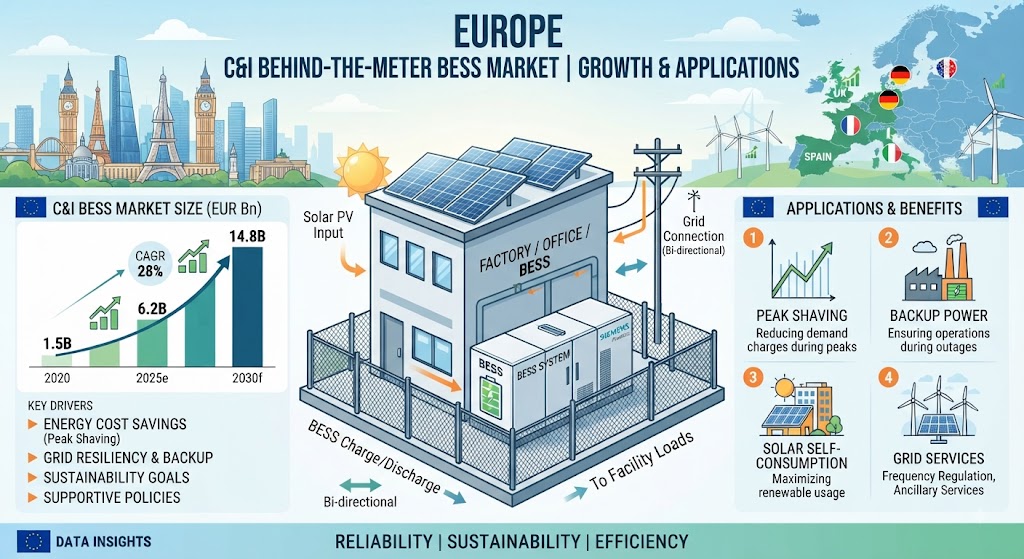
Commercial and industrial businesses are now seeking greater protection from unpredictable electricity costs. BtM battery storage enables companies to reduce reliance on expensive grid electricity during peak demand periods by storing energy when prices are lower and discharging it during high-cost periods. This strategy, known as peak-shaving and energy arbitrage, helps businesses optimize energy expenses while improving operational stability.
As power price volatility continues across European electricity markets, battery storage is becoming an essential tool for financial risk management and energy independence.
Renewable Energy Integration and Decentralization
The rapid expansion of renewable energy across Europe is another major growth driver for BtM BESS adoption. Solar and wind energy are playing an increasingly important role in Europe’s decarbonization strategy, but their intermittent nature creates fluctuations in electricity generation and grid stability challenges.
Battery storage systems help businesses maximize the value of onsite renewable energy installations by storing excess electricity generated from solar photovoltaic (PV) systems and using it when renewable output declines or electricity prices rise. This improves self-consumption rates, reduces grid dependency, and enhances overall energy efficiency.
The EU’s push toward decentralized energy infrastructure is also encouraging the deployment of distributed energy resources (DERs), including battery storage systems. Governments and regulators across Europe are increasingly supporting localized flexibility solutions to strengthen grid resilience and reduce congestion.
Demand Response and Flexibility Market Opportunities
BtM battery storage is creating new revenue opportunities for commercial and industrial energy users through participation in flexibility and demand response markets. Businesses can now monetize their battery assets by providing grid-balancing services such as frequency regulation, reserve capacity, and dynamic load management.
Through aggregators and Virtual Power Plants (VPPs), multiple distributed battery systems can be combined into larger networks that support electricity grid operations. As renewable energy penetration increases, European grid operators are placing greater value on flexible energy resources that can respond quickly to fluctuations in supply and demand.
This shift is transforming battery storage from a passive infrastructure investment into an active revenue-generating asset. Companies adopting BtM BESS are not only reducing energy costs but also participating directly in Europe’s evolving energy markets.
Declining Battery Costs and Technology Advancements
Falling battery prices and advancements in energy management technologies are significantly improving the economic viability of BtM battery storage projects. Lithium-ion battery costs have declined substantially over the past decade, making storage systems more accessible for commercial and industrial users.
At the same time, AI-driven energy optimization platforms are improving battery performance and operational efficiency. Smart software systems can analyze electricity prices, forecast energy demand, and automate charging and discharging cycles to maximize savings and revenues.
Innovative business models such as Energy-as-a-Service (EaaS), battery leasing, and shared ownership agreements are also lowering upfront investment barriers for businesses. These models allow companies to adopt battery storage without large capital expenditures, accelerating market penetration across Europe.
Policy Support and Sustainability Goals
European climate policies and corporate sustainability commitments are further accelerating BtM BESS deployment. The European Union’s carbon reduction targets and renewable energy initiatives are encouraging industries to reduce emissions and improve energy efficiency.
Many corporations are adopting Environmental, Social, and Governance (ESG) strategies that prioritize clean energy investments and carbon footprint reduction. Battery storage systems support these goals by enabling greater renewable energy usage and reducing dependence on fossil-fuel-based grid electricity.
In addition, several EU countries are introducing regulatory reforms and financial incentives that support energy storage deployment, flexibility markets, and decentralized power systems. These supportive policy frameworks are expected to drive long-term growth in the BtM BESS market.
Challenges and Future Outlook
Despite strong market momentum, several challenges remain for the EU BtM BESS sector. High upfront installation costs, regulatory fragmentation across member states, battery degradation concerns, and grid interconnection complexities continue to affect project development.
However, the long-term outlook remains highly positive. Continued declines in battery costs, improvements in energy optimization technologies, and stronger policy support are expected to accelerate adoption throughout the decade.
By 2030, Behind-the-Meter battery storage is likely to become a foundational component of Europe’s decentralized and flexible energy ecosystem. As businesses prioritize resilience, sustainability, and energy independence, BtM BESS will play an increasingly important role in shaping the future of Europe’s commercial and industrial energy landscape.
Conclusion
The rise of Behind-the-Meter battery storage reflects a broader transformation in Europe’s energy sector. Commercial and industrial businesses are no longer passive electricity consumers; they are becoming active energy managers capable of optimizing costs, generating flexibility revenues, and supporting grid stability.
Driven by rising electricity prices, renewable energy growth, declining battery costs, and supportive EU policies, the BtM BESS market is expanding rapidly across Europe. As the region continues its transition toward a decentralized, low-carbon energy system, battery storage will become a critical enabler of industrial energy independence and long-term energy resilience.