
Beyond Lithium-Ion: Technologies Driving the EU Long-Duration Energy Storage Market
Introduction
As Europe accelerates its transition toward a low-carbon energy system, the need for reliable and flexible energy storage solutions is becoming increasingly critical. The rapid deployment of renewable energy sources such as solar and wind has significantly increased the demand for technologies capable of balancing electricity supply and demand over extended periods. While lithium-ion batteries currently dominate the energy storage market, their typical discharge duration of two to four hours limits their ability to address longer-duration grid balancing requirements.
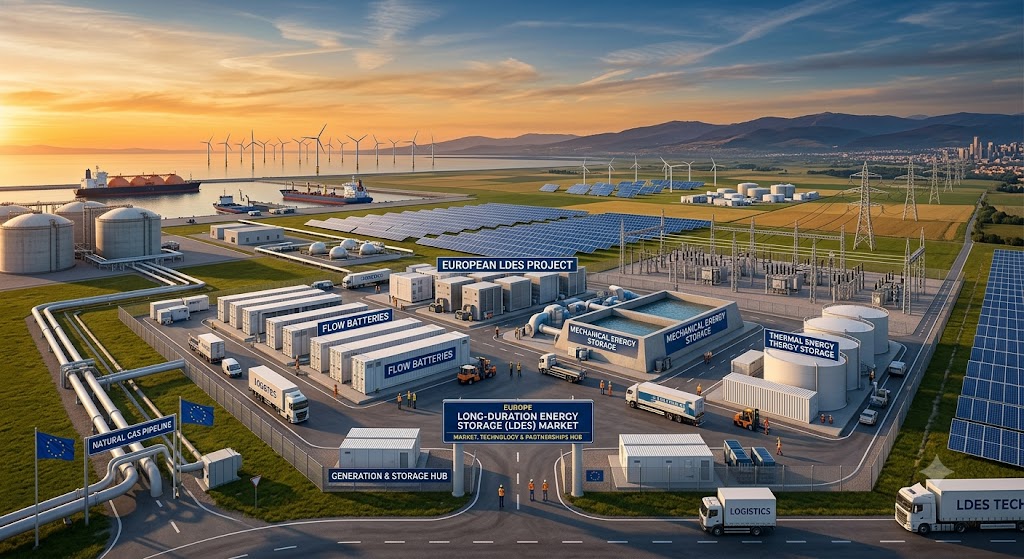
This challenge has led to growing interest in Long-Duration Energy Storage (LDES) technologies, which can store energy for eight hours or more and, in some cases, for several days or even weeks. Across the European Union, policymakers, utilities, grid operators, and investors are exploring a wide range of storage technologies beyond lithium-ion to support grid reliability, renewable integration, and energy security. As Europe moves toward a highly renewable electricity system, LDES is emerging as a crucial pillar of the continent’s energy transition strategy.
Why Europe Needs Long-Duration Energy Storage
Europe's renewable energy capacity continues to expand rapidly as countries pursue ambitious decarbonization targets and energy independence goals. However, renewable generation is inherently variable. Solar output declines at night, while wind generation can fluctuate significantly depending on weather conditions. These variations create challenges for grid operators seeking to maintain a stable electricity supply.
Short-duration batteries are effective for managing hourly fluctuations, but they are often insufficient for addressing multi-day renewable generation gaps, seasonal demand shifts, or prolonged periods of low wind and solar output. Long-duration energy storage technologies provide a solution by storing excess renewable electricity during periods of high generation and releasing it when needed over extended durations.
In addition to supporting renewable integration, LDES can enhance grid resilience, reduce reliance on fossil-fuel peaker plants, improve energy security, and help stabilize electricity prices across European energy markets.
Pumped Hydro Storage: Europe’s Largest LDES Technology
Pumped hydro storage remains the most established and widely deployed form of long-duration energy storage in Europe. The technology works by pumping water from a lower reservoir to an upper reservoir when excess electricity is available and releasing it through turbines when power is needed.
Pumped hydro offers large-scale storage capacity, long asset lifetimes, and proven operational reliability. Several European countries, including Austria, Switzerland, Spain, and Norway, have extensive pumped hydro infrastructure that plays a critical role in balancing renewable energy generation.
While pumped hydro continues to dominate installed storage capacity, future growth may be constrained by geographical limitations, environmental considerations, and lengthy permitting processes. Nevertheless, it remains a foundational component of Europe’s long-duration storage ecosystem.
Green Hydrogen Storage: Unlocking Seasonal Flexibility
Green hydrogen is emerging as one of the most promising long-duration energy storage technologies in Europe. Excess renewable electricity is used to power electrolyzers that split water into hydrogen and oxygen. The hydrogen can then be stored for extended periods and later converted back into electricity through fuel cells or gas turbines.
One of hydrogen’s greatest advantages is its ability to provide seasonal energy storage. Unlike conventional batteries, hydrogen can store energy for weeks or months, making it particularly valuable for addressing prolonged renewable generation shortfalls.
The European Union is heavily investing in hydrogen infrastructure as part of its broader energy transition strategy. Green hydrogen is expected to play a significant role not only in power storage but also in industrial decarbonization, transportation, and energy security initiatives.
Flow Batteries: Scalable and Durable Storage
Flow battery technology is gaining increasing attention as a potential alternative to lithium-ion systems for long-duration applications. Unlike conventional batteries that store energy within solid electrodes, flow batteries store energy in liquid electrolytes contained in external tanks.
This design allows storage duration to be increased simply by expanding electrolyte volume, making flow batteries highly scalable. They also offer long operational lifetimes, minimal degradation, and improved safety characteristics compared to traditional lithium-ion batteries.
Vanadium redox flow batteries currently lead commercial deployment efforts, although iron-based and zinc-based flow battery technologies are also advancing rapidly. As manufacturing scales and costs decline, flow batteries are expected to become an increasingly important component of Europe long-duration storage market.
Thermal Energy Storage and Emerging Technologies
Thermal energy storage is another promising segment within the EU’s LDES landscape. These systems store energy in the form of heat or cold and release it when required. Technologies such as molten salt storage, high-temperature thermal batteries, and compressed thermal energy systems are gaining interest for industrial and grid-scale applications.
Compressed Air Energy Storage (CAES) is another emerging technology that stores energy by compressing air in underground caverns or storage vessels. When electricity is needed, the compressed air is released through turbines to generate power.
Gravity-based energy storage systems are also attracting investment. These technologies store energy by lifting heavy masses and releasing them when electricity demand increases. While still at an early stage of commercialization, gravity storage offers the potential for long asset lifetimes and minimal environmental impact.
Together, these emerging technologies are expanding the range of solutions available to support Europe's future energy system.
Investment Trends and Policy Support
The EU’s commitment to achieving climate neutrality by 2050 is creating strong momentum for long-duration energy storage investment. Governments, utilities, infrastructure funds, and private investors are increasingly recognizing the importance of LDES in enabling a high-renewable electricity system.
Several European countries are introducing energy storage support mechanisms, innovation funding programs, and regulatory reforms designed to accelerate commercialization. Public-private partnerships and research initiatives are also driving technological advancements and cost reductions across multiple storage technologies.
As investment increases, Europe is positioning itself as a global leader in the development and deployment of next-generation energy storage solutions.
Challenges and Future Outlook
Despite significant progress, the LDES market faces several challenges. High capital costs, technology commercialization risks, regulatory uncertainty, and limited revenue certainty continue to affect project development. Many technologies remain in early deployment stages and require further scale-up before achieving widespread adoption.
However, the long-term outlook remains highly positive. As renewable energy penetration increases and electricity systems become more dependent on flexibility resources, demand for long-duration storage will continue to grow. Technological innovation, supportive policy frameworks, and declining costs are expected to accelerate market expansion throughout the decade.
Conclusion
While lithium-ion batteries will continue to play an important role in short-duration storage applications, Europe’s long-term energy transition requires a broader portfolio of energy storage technologies. Pumped hydro, green hydrogen, flow batteries, thermal storage, compressed air systems, and other emerging solutions are all expected to contribute to a more resilient and flexible electricity system.
As the European Union advances toward its climate and energy security objectives, long-duration energy storage will become a cornerstone of renewable integration and grid stability. The technologies emerging beyond lithium-ion are set to shape the future of Europe’s energy infrastructure and unlock the full potential of a carbon-neutral power system.