
UK Nuclear New-Build & Supply-Chain Market 2026–2030
Report Description
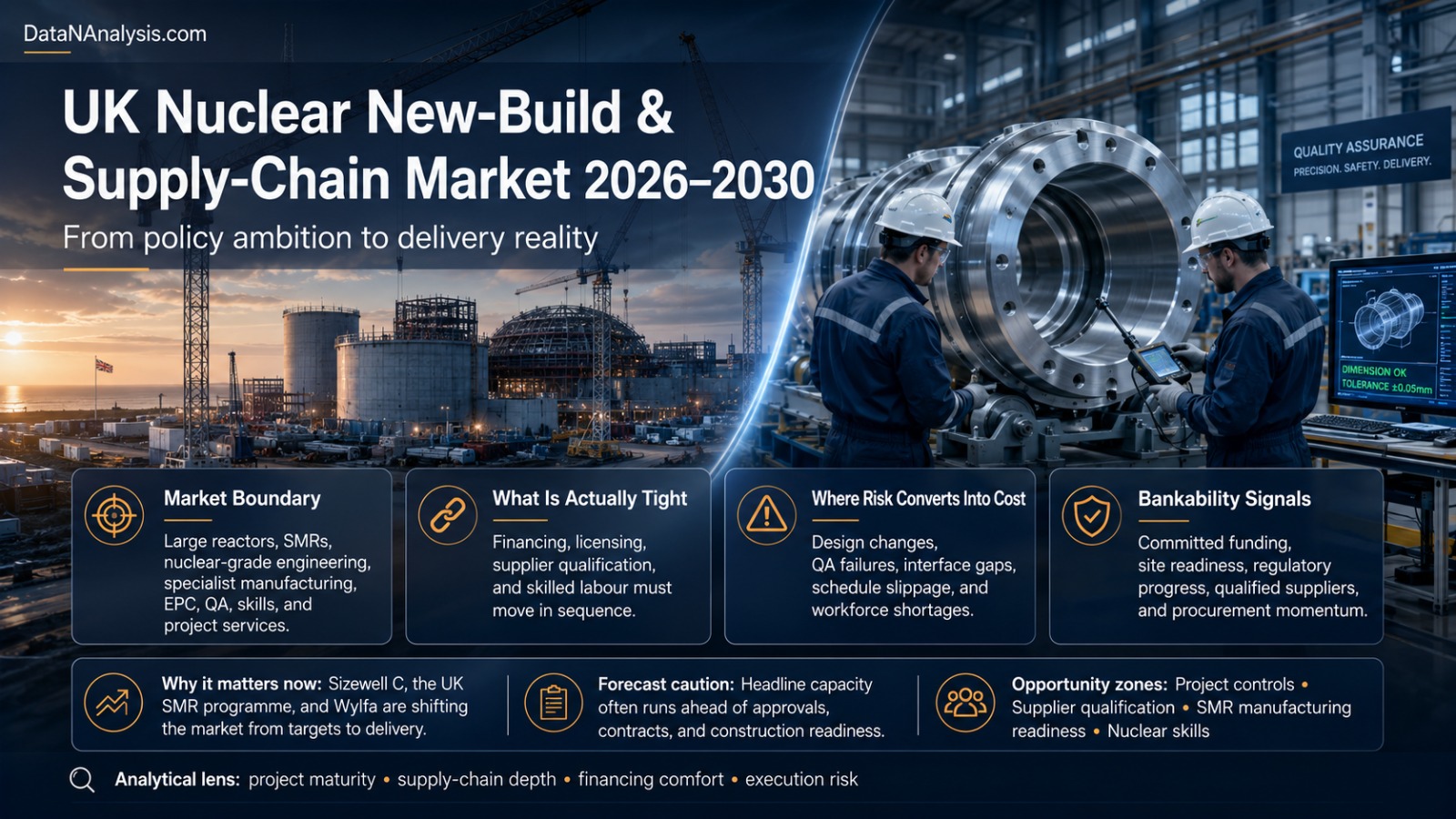
The UK Nuclear New-Build & Supply-Chain Market matters because the country has moved from nuclear ambition into a more demanding delivery phase. Sizewell C, the Rolls-Royce SMR programme, Wylfa site selection, life-extension decisions, and regulatory reform now create a more visible pipeline than the UK has had for years. The issue is no longer whether nuclear is politically supported. The harder question is whether financing, regulatory readiness, grid interface, construction capability, component supply, and nuclear skills can convert policy commitment into bankable capacity. This market will not reward announcement volume. It will reward developers, OEMs, EPCs, investors, and suppliers that can prove delivery credibility, risk discipline, and long-cycle execution capability. DataNAnalysis.com examines the UK nuclear market through project maturity, supply-chain depth, financing comfort, regulatory progress, workforce readiness, and execution risk rather than headline capacity targets.
Scope of the Study
Key Insights
- 1When the UK shifts from policy ambition to committed nuclear construction, supplier qualification becomes a commercial gatekeeper, which means early-positioned nuclear-grade vendors gain more value than generic construction contractors.
- 2When Sizewell C moves deeper into procurement and construction planning, Hinkley Point C learning transfer matters, which means proven EPR delivery experience becomes a stronger bankability signal than broad infrastructure experience.
- 3When Wylfa becomes the first UK SMR site, the market consequence is a new supplier pathway for modular nuclear, which means manufacturers with repeatable quality systems may benefit before full commercial power generation arrives.
- 4When nuclear financing relies on public balance sheet support and consumer-backed models, cost discipline becomes political risk, which means lenders and infrastructure funds will test governance, risk allocation, and schedule realism harder.
- 5When the UK tries to rebuild nuclear capability while also expanding grids, renewables, defence nuclear, and clean-industry infrastructure, skilled labour becomes a shared constraint, which means workforce access may decide project pace as much as technology selection.
Above-the-Fold Snapshot
Market Boundary
This market covers the UK’s civil nuclear new-build and enabling supply chain, including large-scale reactor delivery, SMR deployment preparation, nuclear-grade engineering, licensing, project controls, skilled labour, specialist construction, component manufacturing, and long-cycle supplier qualification.
What Is Actually Tight
The tightest constraint is not political support. It is the UK’s ability to synchronize financing, licensing, construction sequencing, nuclear-grade supply, and skilled labour across Sizewell C, Hinkley Point C, SMR preparation, and future fleet options.
Where Risk Converts Into Cost
Risk converts into cost through late design changes, nuclear-grade quality failures, contractor underperformance, financing delays, regulatory rework, shortage of certified labour, and weak interface management between civil works, mechanical systems, grid connection, and commissioning.
What Separates Bankable From Announced
Bankable opportunities show site control, regulatory progress, committed funding, credible delivery partners, qualified suppliers, grid pathway visibility, workforce planning, procurement momentum, and governance strong enough to survive cost escalation and schedule pressure
Country-Specific Market Dynamics
Demand/Policy Logic
UK nuclear demand is forming around energy security, firm low-carbon power, clean power system reliability, ageing reactor replacement, industrial strategy, and domestic supply-chain renewal. The policy signal is stronger than in previous cycles because nuclear is now tied to sovereign energy resilience, long-duration baseload capacity, and national manufacturing opportunity. Sizewell C provides the large-project anchor, while Rolls-Royce SMR and Wylfa create a second pathway around fleet-based modular deployment.
Supply / Delivery Logic
Delivery is constrained by the UK’s recent nuclear construction track record, limited nuclear-grade supplier depth, long approval cycles, pressure on skilled labour, financing scrutiny, and the complexity of moving from one-off mega-projects to repeatable nuclear delivery. The market will scale unevenly. Engineering, project controls, civil works, digital QA, supplier qualification, and nuclear skills may see earlier demand than reactor deployment revenue.
Why Forecasts Go Wrong in This Country
Mechanism
Analysts usually over-assume that policy targets, project announcements, and technology selection directly translate into near-term market value.
Direction
The UK market can scale slower than headline policy suggests because nuclear projects convert through staged financing, licensing, procurement, construction, and commissioning gates. At the same time, supply-chain activity can scale earlier than power generation because engineering, site works, procurement, and qualification begin well before commercial operation.
Where It Shows Up
Forecast error becomes visible in procurement slippage, delayed supplier awards, cost revisions, grid-interface delays, workforce shortages, regulatory rework, and mismatch between announced capacity and executable project milestones.
Decision Implication
This report reduces forecast error by weighting executable signals: funding status, licensing stage, supplier awards, site readiness, regulatory movement, construction sequencing, skilled labour access, and project governance rather than headline capacity targets.
Driver Impact Table
|
Driver |
Where It Bites First |
Who It Impacts Most |
How We Measure It |
|
Sizewell C delivery commitment |
Nuclear-grade procurement and construction supply chain |
EPCs, civil contractors, component suppliers, project-control firms |
FID status, contract awards, work-package sequencing, supplier onboarding |
|
Rolls-Royce SMR and Wylfa pathway |
Modular manufacturing, design approval, site preparation |
OEMs, specialist manufacturers, engineering firms, investors |
Contract milestones, regulatory design progress, site development activity |
|
UK energy-security policy support |
Long-term nuclear capacity planning |
Utilities, government-backed entities, infrastructure funds |
Policy commitments, budget allocations, public equity participation |
|
Nuclear skills and industrial strategy |
Labour availability and supplier qualification |
Developers, EPCs, training providers, regional clusters |
Workforce plans, apprenticeship intake, skill-gap assessments, project hiring |
Drag Impact Table
|
Drag |
Where It Bites First |
Who It Impacts Most |
How We Measure It |
|
Cost escalation and schedule risk |
Mega-project financing and IC approvals |
Government, investors, consumers, lenders |
Cost revisions, contingency use, delivery slippage, NAO-style risk findings |
|
Nuclear-grade supplier bottlenecks |
Component manufacturing and QA |
OEMs, Tier-1 suppliers, specialist fabricators |
Supplier qualification rates, QA failures, procurement delays |
|
Regulatory and planning complexity |
Site development and design changes |
Developers, regulators, legal advisers, local authorities |
Licence progress, planning conditions, regulatory holds, design modifications |
|
Workforce shortage |
Construction, commissioning, and operations readiness |
EPCs, operators, training bodies, regional employers |
Vacancy rates, skill pipeline, wage pressure, training capacity |
Opportunity Zones & White Space
- Nuclear-grade project controls and cost-risk analytics
The opportunity exists because UK nuclear delivery faces high scrutiny on budget, schedule, and public-risk exposure. Developers, lenders, and government bodies benefit. The confirming signal is demand for stronger earned-value tracking, claims control, and transparent risk governance. - Supplier qualification and QA support for UK SMEs
The opportunity exists because many domestic suppliers may have industrial capability but lack nuclear-grade qualification depth. Specialist consultants, certification firms, and Tier-1 integrators benefit. The confirming signal is rising supplier onboarding linked to Sizewell C and SMR work packages. - SMR manufacturing-readiness services
The opportunity exists because SMRs require repeatable manufacturing logic, not only project engineering. OEM partners, advanced manufacturers, and regional industrial clusters benefit. The confirming signal is movement from technology selection into design, factory planning, and site-specific development. - Nuclear workforce development and regional training hubs
The opportunity exists because the UK must support large nuclear construction, SMRs, decommissioning, and defence nuclear in parallel. Training providers, employers, local authorities, and project owners benefit. The confirming signal is employer-funded training, regional nuclear-skills hubs, and project-specific hiring plans.
Competitive Reality
Competitive advantage in the UK nuclear new-build market is shifting from policy access to delivery credibility. The strongest players will not be those with the largest announced pipeline, but those with proven nuclear-grade QA, skilled labour access, cost-control discipline, regulatory familiarity, and ability to manage complex interfaces across engineering, civil works, manufacturing, safety case, grid connection, and commissioning. For suppliers, the practical question is whether they can pass qualification, sustain documentation discipline, and deliver under nuclear assurance requirements. For developers and investors, the test is whether each project has a credible route through financing, licensing, procurement, and construction gates.
Strategy Pattern Table
|
Winning Play |
Why It Works |
Signal to Watch |
|
Anchor around Sizewell C work packages |
Large-reactor procurement creates near-term supply-chain demand before new capacity is online |
Tier-1 awards, local supplier contracts, civil works ramp-up |
|
Build SMR fleet-readiness capability early |
SMR value will form around design approval, modular supply chain, and repeatable manufacturing |
Rolls-Royce SMR contract progress, Wylfa site milestones, factory-readiness disclosures |
|
Combine nuclear QA with cost-risk governance |
Public and lender scrutiny makes delivery control a buying criterion |
Audit findings, revised project budgets, lender due diligence requirements |
Decision Boxes
Investor / IC Decision Box
Before believing the opportunity, investors should test whether the project has committed funding, clear risk allocation, regulatory momentum, credible procurement sequencing, realistic cost assumptions, and suppliers with nuclear-grade delivery records.
Bank / Lender Decision Box
Financing comfort improves when projects show transparent cost governance, contingency discipline, committed equity, stable policy support, grid pathway visibility, strong construction controls, and contractual clarity on delay, defect, and interface risk.
Developer / OEM / EPC / Operator Decision Box
The winning capability is integrated delivery control: supplier qualification, nuclear QA, workforce planning, regulator engagement, modularization discipline, site readiness, and the ability to convert lessons from Hinkley Point C into lower execution risk at Sizewell C and future SMR projects.
Methodology Summary
The report builds the 2026–2030 outlook from delivery mechanics rather than headline announcements. DataNAnalysis.com evaluates policy signals, project maturity, financing structure, regulatory progress, site readiness, supply-chain depth, skilled-labour availability, procurement activity, grid interface, competitive intensity, and execution risk to assess which parts of the UK nuclear market are commercially viable within the forecast period.
Limitations Box
- Project-level cost, supplier margin, and private contract data remain partly opaque.
- SMR timing is uncertain because site development, design approval, financing, and licensing must still convert into executable milestones.
- Policy, regulatory, and public-finance decisions may change project economics or delivery pace during 2026–2030.
What You Get
- Country-level PDF report
- Excel data pack
- Market sizing and forecast assumptions
- Segment-level analysis
- Project, company, and opportunity mapping
- Driver and drag impact tables
- Competitive and strategy analysis
- Analyst Q&A
Source Map
- UK Department for Energy Security and Net Zero
- Office for Nuclear Regulation
- Great British Energy – Nuclear / Great British Nuclear disclosures
- Sizewell C project disclosures
- National Energy System Operator and clean power planning sources
- National Audit Office and parliamentary evidence
- Nuclear Industry Association and nuclear skills sources
- Utility, OEM, EPC, and supplier announcements
- Infrastructure finance and credible energy news sources
Why Purchase This Report?
IC-Defensible Thesis, Not “Market Size”
A decision frame you can take into committee: boundary, base case, and what would change our view.
Evidence Ladder You Can Audit
Artefacts-led (grid offers, tenders, term-sheet structures, warranty language), mapped to what each proves and where it fails.
IRR Kill-Shots and Early Signals
The repeatable ways projects miss IRR (timeline, capex, availability, settlement): plus the first signals that show up before the slide.
Regime Classes and Dominant Variables
Why identical assets underperform in different environments: the one variable that dominates returns by regime (payer, settlement, constraints, curtailment logic.
Table of Contents
UK Nuclear New-Build & Supply-Chain Market 2026–2030
1. Executive Brief/Summary (What Everyone’s Missing)
1.1 Market Size & Forecast (2026–2030)
1.2 Where Most Forecasts Go Wrong and Where the Money’s Actually Going
1.3 High-Level Opportunity Snapshot
2. Research Architecture & Field Intelligence
2.1 Research Methodology & Data Sources
2.2 Top 3 Growth Signals from Market Stakeholders
2.3 Execution Friction: Where Projects Fail in Reality
3. Demand Outlook
3.1 Key demand drivers, focused on what changes decisions
3.2 Underserved Buyer Segments & Use Cases
3.3 Procurement and Pricing Patterns
4. Opportunity and White Space Map
4.1 Two Priority Segments to Watch
4.2.Regions / verticals with high pain, low competition
4.3. Integration Gaps and Pricing Bands that still work
4.4. Top Risks & Practical de-risk Levers
5 Competitive Intelligence: Strategic Benchmarking
5.1 Market Share Breakdown: Key Players (2024/25E)
5.2 Who’s Gaining Share, and Why (Talent, M&A, Policy Edge)
5.3 Challenger Playbook: How Smaller Players Are Quietly Winning
5.4. Company Profiles
5.4.1. Company 1
5.4.2. Company 2
5.4.3. Company 3
5.4.4. Company 4
5.4.5. Company 5
5.5. Capital flows:
5.5.1. By Investor Type (VC, PE, Infra, Strategics)
5.5.2. Investment Patterns, M&A, JV, and Expansion Moves
6. Market Segmentation
6.1 By Reactor Technology Type
6.1.1 Large Generation III/III+ Reactors
6.1.2 Small Modular Reactors (SMRs)
6.1.3 Advanced / Gen IV Demonstration Reactors
6.1.4 Research & Test Reactors
6.1.5 Others
6.2 By Project Scope (Supply-Chain Focus)
6.2.1 Nuclear Island Equipment
6.2.2 Conventional Island Equipment
6.2.3 Balance of Plant (BoP) Systems
6.2.4 Fuel Supply & Fabrication
6.2.5 Others
6.3 By Build Status
6.3.1 New Greenfield Projects
6.3.2 Restarted / Revived Projects
6.3.3 First-of-a-Kind (FOAK) Builds
6.3.4 Fleet / Repeat Builds
6.3.5 Others
6.4 By Buyer / Project Owner Type
6.4.1 State-Owned Utilities
6.4.2 National Nuclear Operators
6.4.3 Consortium / JV-Led Projects
6.4.4 Private / Merchant Developers
6.4.5 Others
7. Action Frameworks for 2025–2028
7.1 Market Entry Options by Archetype (Builders, Tech Entrants, Investors)
7.2 Three realistic GTM Patterns
7.3 Strategic Watchlist: What to Monitor Quarterly
8. IC-Ready Decision Pack (Slides You Can Reuse Directly)
8.1. One-page IC Summary (yes/no, where, how)
8.2. 4-5 IC slides you can re-use (market thesis, risk & mitigants, competition)
8.2. Cheat sheets
8.4 Country / Segment Prioritization Slide
8.5 “Go / No-Go” Checklist for 2025–2028
Appendix: Reference Frameworks & Background:
- A1. Regulatory overview (high-level, with links to primary docs)
- A2. PESTLE snapshot
- A3. Porters (one slide max, if at all)
- A4. Supply chain maps
- A5. Price band tables
Research Methodology
No research methodology information available for this report.
Frequently Asked Questions
Research Grounded in Verifiable Inputs
Our research draws on publicly verifiable inputs including regulatory filings, grid operator data, project announcements, and policy documents across Europe.
These inputs are cross-checked through structured discussions with industry participants to validate what is progressing in practice versus what remains theoretical.
Analyst-Led Research Support
Each report is supported by analysts who focus on specific energy domains and regions. Clients can discuss assumptions, clarify findings, and explore implications with analysts who follow these markets on an ongoing basis
Energy Insights,
Straight to Your Inbox
For People Who Sign Off on Energy Decisions.
Short updates on EU power, grids, storage, and execution risk. No spam, just what matters.
Unsubscribe anytime. No spam, ever.