
Why Grid-Scale Battery Storage is Becoming Europe’s Backbone for Renewable Integration
Introduction
Europe’s transition toward a low-carbon energy system is accelerating rapidly as governments push for ambitious climate targets and renewable energy deployment. Solar and wind power are now central to the European Union’s decarbonization strategy, helping reduce dependence on fossil fuels and improve long-term energy security. However, the rapid expansion of renewable energy also presents major challenges for electricity grids because renewable generation is intermittent and highly dependent on weather conditions.
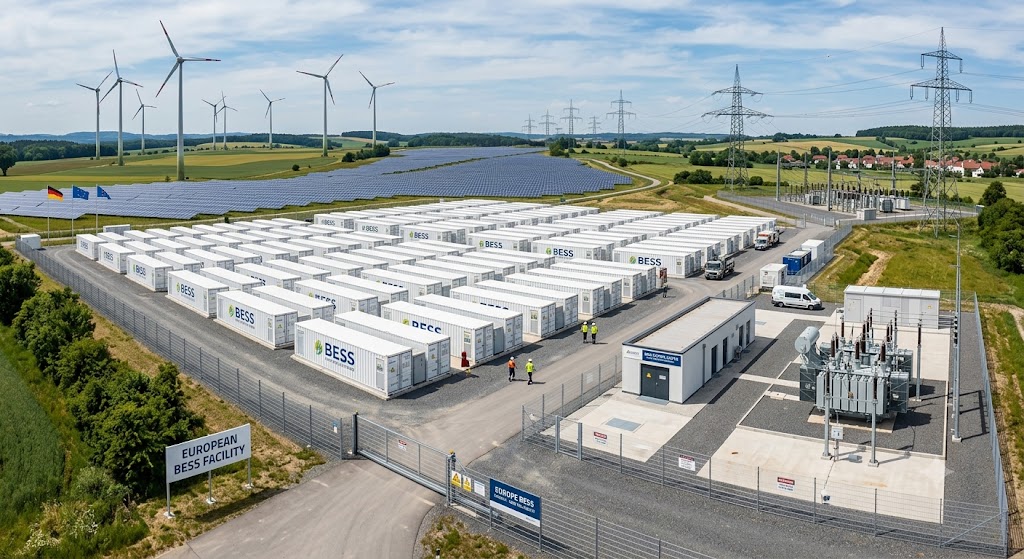
To address these challenges, Grid-Scale Battery Energy Storage Systems (BESS) are emerging as one of the most important technologies supporting Europe’s energy transition. Large-scale battery storage projects are helping stabilize electricity networks, improve renewable energy integration, reduce grid congestion, and provide critical flexibility services. Across Europe, governments, utilities, grid operators, and private investors are increasingly viewing battery storage as the backbone of a reliable and renewable-powered electricity system.
Europe’s Renewable Energy Expansion Is Driving Storage Demand
The rapid growth of renewable energy generation across Europe is one of the biggest drivers behind grid-scale battery storage deployment. Countries such as Germany, Spain, the Netherlands, France, Italy, and the UK are significantly expanding solar photovoltaic (PV) and offshore wind capacity to meet climate and energy security goals.
While renewable energy offers major environmental and economic benefits, it also creates operational challenges for electricity grids. Solar and wind power generation fluctuate depending on weather conditions, leading to periods of oversupply and undersupply. Traditional electricity systems were designed around stable fossil fuel power plants, making it difficult to manage large volumes of intermittent renewable generation.
Grid-scale battery storage helps solve this challenge by storing excess renewable electricity during periods of high generation and discharging it when renewable output declines or electricity demand increases. This flexibility enables renewable energy to become a more reliable and stable source of power for Europe’s electricity networks.
Grid Stability and Frequency Regulation
One of the most important functions of grid-scale battery storage is maintaining grid stability. Electricity grids require a constant balance between supply and demand to operate efficiently. Even small imbalances can create frequency fluctuations that threaten grid reliability and increase the risk of power outages.
Battery storage systems can respond within milliseconds to sudden changes in electricity demand or renewable generation. This makes them highly effective for frequency regulation and ancillary services. Grid operators across Europe increasingly rely on battery storage to stabilize networks and support renewable-heavy electricity systems.
Unlike traditional fossil fuel power plants, battery systems provide extremely fast-response balancing capabilities without producing carbon emissions. As renewable penetration continues to increase, the demand for battery-based grid stabilization services is expected to grow significantly throughout Europe.
Reducing Renewable Curtailment and Grid Congestion
Another major challenge facing Europe’s renewable energy expansion is grid congestion. In many regions, electricity infrastructure has not expanded fast enough to support the rapid growth of renewable generation capacity. As a result, renewable energy producers are sometimes forced to curtail generation because grids cannot absorb excess electricity supply.
Grid-scale battery storage helps reduce renewable curtailment by storing surplus electricity and releasing it later when demand increases or grid conditions improve. This improves renewable energy utilization rates and increases the efficiency of clean energy investments.
Battery storage also supports transmission and distribution infrastructure by reducing stress on overloaded electricity networks. In congested regions, storage systems can defer expensive grid upgrades while improving system flexibility and resilience.
Supporting Europe’s Energy Security Goals
Europe’s energy security priorities have become increasingly important following geopolitical tensions and disruptions in natural gas supply chains. Many European countries are now accelerating renewable energy deployment to reduce dependence on imported fossil fuels and strengthen domestic energy resilience.
Grid-scale battery storage plays a critical role in supporting this transition by enabling greater integration of locally generated renewable energy. By storing renewable electricity and improving grid flexibility, battery systems help reduce reliance on gas-fired peaking plants and imported fuels.
Battery storage is therefore becoming an important component of Europe’s broader strategy for improving energy independence, price stability, and long-term energy security.
Declining Battery Costs and Technological Advancements
The rapid decline in lithium-ion battery costs is significantly improving the economic viability of grid-scale battery storage projects. Over the past decade, advances in battery manufacturing, energy density, and supply chain scaling have reduced storage costs and increased deployment across Europe.
At the same time, AI-driven energy management software and advanced forecasting systems are improving battery performance and operational efficiency. Modern battery storage systems can now optimize charging and discharging cycles based on electricity prices, renewable generation forecasts, and grid demand conditions.
These technological improvements are attracting major investment from utilities, infrastructure funds, and private equity firms seeking exposure to Europe’s rapidly growing energy storage market.
Policy Support and Investment Momentum
European policymakers are increasingly recognizing battery storage as a critical enabler of the clean energy transition. The European Union’s climate targets, renewable energy directives, and grid modernization initiatives are creating supportive conditions for battery storage deployment.
Several EU countries are introducing flexibility market reforms, energy storage incentives, and faster permitting frameworks to accelerate project development. At the same time, electricity market operators are expanding opportunities for battery systems to participate in ancillary services and balancing markets.
Investment momentum is also growing rapidly. Utilities, energy developers, and institutional investors are investing billions of euros into Europe’s battery storage ecosystem as long-duration energy flexibility becomes increasingly valuable.
Challenges Facing Grid-Scale BESS Deployment
Despite strong growth potential, several challenges still affect Europe’s grid-scale battery storage market. Supply chain constraints for critical minerals such as lithium, nickel, and cobalt can impact battery manufacturing and project costs.
Regulatory uncertainty and fragmented market structures across EU member states also create complexity for developers and investors. In addition, long project approval timelines and grid interconnection bottlenecks remain significant barriers in some regions.
Battery degradation and recycling infrastructure are additional long-term considerations that will require continued technological innovation and policy support.
Future Outlook: Building Europe’s Flexible Energy System
The future of Europe’s electricity system will depend heavily on flexibility technologies capable of balancing large volumes of renewable energy generation. Grid-scale battery storage is expected to become one of the most important pillars of this future energy infrastructure.
As renewable energy capacity continues expanding, battery systems will play a central role in frequency regulation, energy shifting, congestion management, and renewable integration. The growth of electric vehicles, smart grids, hydrogen production, and decentralized energy resources will further increase demand for large-scale energy storage solutions.
By 2030 and beyond, grid-scale BESS is likely to become an essential backbone of Europe’s renewable-powered electricity system.
Conclusion
Grid-scale battery storage is rapidly transforming from an emerging technology into a foundational component of Europe’s energy transition. By improving grid stability, reducing renewable curtailment, supporting energy security, and enabling renewable integration, battery storage is helping reshape Europe’s electricity infrastructure.
Driven by declining costs, supportive policies, and rising renewable energy deployment, grid-scale BESS is becoming indispensable for building a resilient, flexible, and low-carbon energy system across Europe. As the continent accelerates its clean energy ambitions, battery storage will remain at the center of Europe’s renewable integration strategy.