
Transforming Waste into Power: Shaping Europe’s Circular Energy Future
Europe’s waste-to-energy transition follows a clear timeline aligned with the European Union climate goals: by 2030, plants are being upgraded to cut emissions by at least 55% under the European Green Deal; by 2040, they evolve into efficient circular systems with better heat recovery and lower waste; and by 2050, the objective is climate neutrality, with near-zero emissions supported by carbon capture and minimal residual waste.
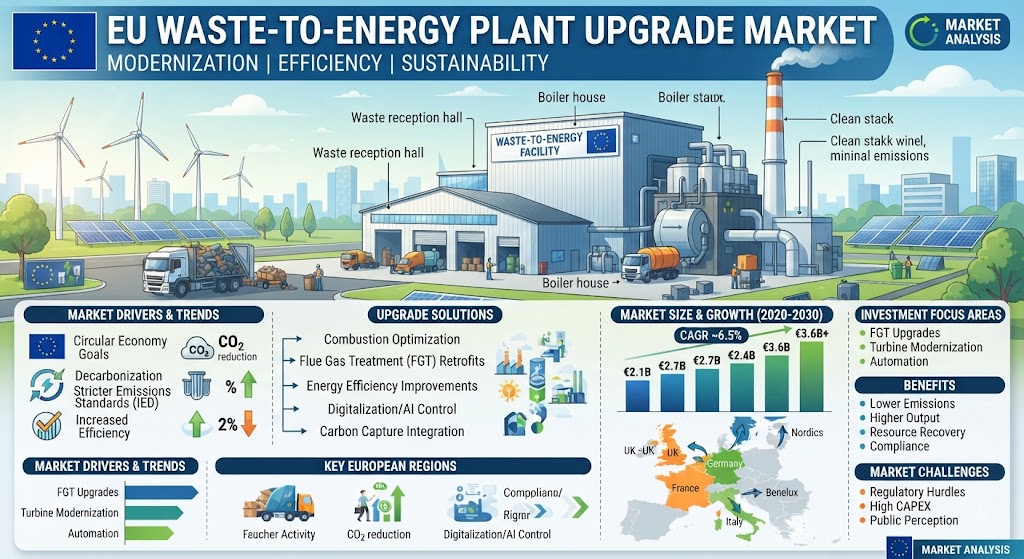
With over 450 operational WtE plants across Europe, the focus is shifting from new construction to modernization and technological upgrades of existing facilities.
The EU Waste-to-Energy Plant Upgrade Market is emerging as a crucial segment, enabling older plants to meet stricter environmental
What is Waste-to-Energy Plant Upgrading?
Waste-to-Energy (WtE) Plant Upgrading refers to the modernization of existing facilities to improve efficiency, reduce environmental impact, and increase energy recovery from waste. It transforms traditional waste disposal units into advanced, sustainable energy systems aligned with circular economy and climate goals.
It is built on three key pillars:
- Efficiency Enhancement: Upgrading turbines, boilers, and heat recovery systems to maximize electricity generation and district heating output.
- Emission Reduction Technologies: Installing advanced flue gas cleaning, filtration systems, and carbon capture solutions to comply with strict EU emission standards.
- Digitalization & Automation: Integrating AI, sensors, and real-time monitoring for optimized performance, predictive maintenance, and reduced downtime.
In addition, modern upgrades increasingly focus on waste type management and segregation, which directly impacts plant efficiency and emissions. Facilities are now designed to handle:
- Municipal Solid Waste (MSW): Proper pre-sorting improves calorific value and combustion efficiency.
- Recyclable Materials Removal: Metals, plastics, and glass are separated before incineration to support recycling and reduce pollution.
- Organic Waste: Can be diverted to anaerobic digestion instead of incineration for better energy recovery.
- Hazardous Waste Control: Specialized handling and treatment systems ensure safe disposal and emission control.
Overall, these upgrades enable WtE plants to operate as high-efficiency energy recovery hubs, supporting sustainability, reducing landfill dependency, and contributing to cleaner energy systems.
Why the EU is Prioritizing Plant Upgrades
The European Union is placing strong emphasis on modernizing Waste-to-Energy (WtE) infrastructure as a strategic enabler of its circular economy, climate, and energy security objectives. This push is driven by a combination of binding regulatory targets, evolving societal expectations, and pressing operational realities.
At the core are the EU’s ambitious landfill reduction targets, which mandate that landfilling of municipal waste must fall below 10% by 2035. With limited remaining landfill capacity and rising environmental costs, WtE has become an essential alternative for managing residual waste that cannot be recycled. Simultaneously, Europe’s transition to a circular economy is redefining waste as a valuable resource, not only for energy generation but also for material recovery, including metals, aggregates, and bottom ash.
The existing WtE plants, built in the 1980s and 1990s, are now approaching the end of their technical lifetime. These aging facilities often fall short of today’s stringent emission standards, energy efficiency requirements, and digital performance expectations. Upgrading them is therefore critical to maintain operational continuity, ensure regulatory compliance, and prevent costly plant closures.
Furthermore, in a post-energy-crisis environment, WtE offers a reliable, dispatchable, and locally sourced form of energy, reducing dependence on imported fossil fuels and supporting grid stability as renewables scale up.
Without timely upgrades, a large share of Europe’s WtE fleet risks becoming inefficient, non-compliant, and economically stranded. Modernization is thus not merely an environmental necessity but a strategic imperative to safeguard energy security, unlock circular value streams, and deliver cost-effective decarbonization across the waste and energy sectors.
Key Market Drivers
The growth of the EU Waste-to-Energy Plant Upgrade Market is largely driven by strong policy support and evolving environmental regulations. European Union directives, such as the Landfill Directive and Industrial Emissions Directive, are pushing operators to upgrade existing plants to meet stricter emission standards and reduce landfill dependency. At the same time, rapid technological advancements including carbon capture systems, advanced gasification methods, and digital monitoring tools are enabling plants to operate more efficiently and sustainably.
In addition, rising waste generation across Europe is increasing the need for effective waste management solutions beyond recycling alone, making energy recovery through upgraded WtE plants more essential. Another important driver is the integration of these plants into district heating and combined heat and power (CHP) systems, which enhances their role in urban energy supply. Together, these factors are accelerating investments in upgrading existing infrastructure, positioning waste-to-energy as a key contributor
EU Waste-to-Energy Plant Upgrade Market: Key Challenges
Despite strong growth potential, the market faces several critical barriers:
- High Capital Investment: Retrofitting existing plants with advanced technologies such as carbon capture, flue gas cleaning, and digital systems requires substantial upfront funding, often limiting smaller operators.
- Regulatory Complexity: Constantly evolving EU environmental and emission standards increase compliance costs and create uncertainty for long-term investment planning.
- Public Opposition: Concerns over emissions, air quality, and environmental impact often lead to project delays, stricter scrutiny, and permitting challenges.
- Technological Uncertainty: Emerging solutions like carbon capture and advanced heat recovery systems are still developing, making them expensive and sometimes commercially unproven at scale.
- Ageing Infrastructure: Many WtE plants across Europe were built decades ago and operate with outdated equipment, resulting in lower efficiency, higher emissions, and increased maintenance costs—making upgrades essential rather than optional.
Addressing these challenges will require coordinated policy support, financial incentives, and investment frameworks to accelerate modernization and ensure WtE plants contribute effectively to Europe’s sustainability and energy transition goals.
Where It Comes to Life: Applications & Use Cases
The impact of WtE plant upgrades is visible across multiple sectors:
- Urban Energy Systems: Supplying electricity and district heating to cities
- Industrial Energy Supply: Supporting manufacturing sectors with stable energy
- Waste Management Systems: Reducing landfill dependency and improving waste utilization
- Circular Economy Models: Recovering metals and materials alongside energy production
Upgraded plants are becoming multi-functional hubs combining waste processing, energy generation, and resource recovery.
Companies Driving the Market
Several major players are actively involved in upgrading Europe’s WtE infrastructure:
- Veolia Environnement – Focus on advanced waste treatment and energy recovery solutions
- SUEZ Group – Investing in smart waste management and circular economy systems
- Hitachi Zosen Inova – Leader in modern WtE plant engineering and upgrades
- Babcock & Wilcox – Providing advanced combustion and emission control technologies
- Ramboll Group – Engineering consultancy supporting plant optimization and modernization
These companies are integrating digital tools, emissions control, and efficiency technologies into existing plants.
Conclusion: Powering Europe’s Circular Energy Future
The EU Waste-to-Energy (WtE) Plant Upgrade Market represents a critical enabler of Europe’s transition toward a circular, low-carbon economy. As waste volumes continue to grow and environmental regulations become increasingly stringent, upgrading existing plants has emerged as a more practical, cost-effective, and sustainable approach than developing new facilities from the ground up.
Through targeted investments in digitalization, advanced emissions control, and higher energy efficiency, modernized WtE plants are well positioned to deliver multiple strategic benefits: significantly reducing reliance on landfills, generating reliable renewable energy, and strengthening Europe’s energy security by providing a stable, locally sourced power supply.
While challenges such as high capital costs and regulatory complexity persist, rapid technological innovation and strong policy support are redefining waste as a strategic energy and material resource. This positions the WtE upgrade market as a key pillar in building a cleaner, more resilient, and resource-efficient European energy system.