
The Rise of Flexibility Markets: Opportunities for Grid Congestion Service Providers Across the EU
Introduction
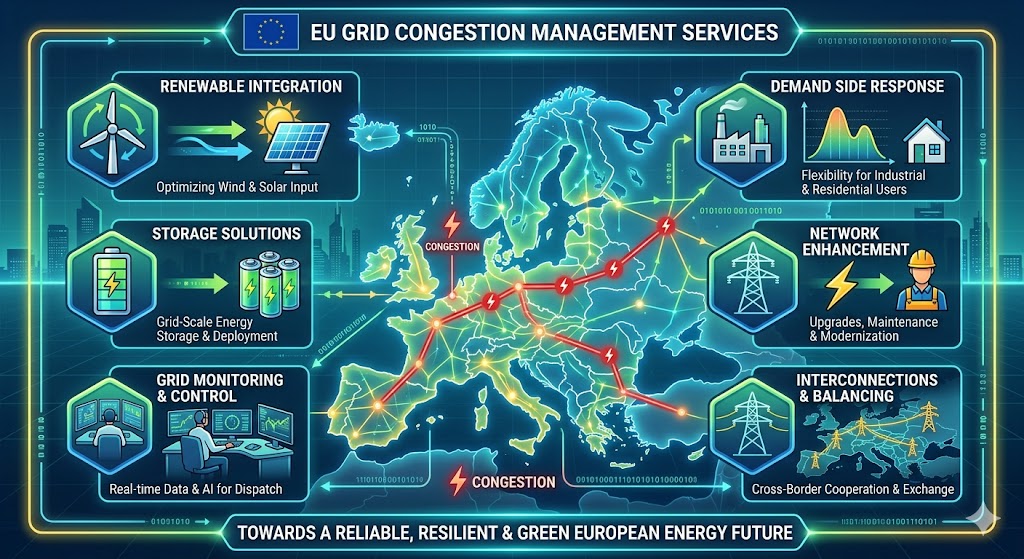
Europe’s energy transition is fundamentally transforming the way electricity systems operate. The rapid deployment of renewable energy sources, increasing electrification of transport and industry, and the decentralization of power generation are creating both opportunities and challenges for grid operators. Among the most pressing challenges is managing grid congestion while ensuring reliable and affordable electricity supply.
Traditionally, grid operators relied heavily on network expansion and conventional power plants to maintain system stability. However, as renewable energy penetration grows, these approaches alone are no longer sufficient. This has led to the emergence of flexibility markets, where energy consumers, producers, storage operators, and aggregators are rewarded for providing services that help balance supply and demand and alleviate network constraints.
Across the European Union, flexibility markets are rapidly gaining momentum as a cost-effective solution for managing congestion and integrating renewable energy. For grid congestion service providers, this shift is creating significant business opportunities while supporting Europe’s broader decarbonization goals.
Understanding Flexibility Markets
Flexibility markets are platforms or mechanisms that enable participants to offer services that help electricity networks operate more efficiently. These services can include reducing electricity consumption, increasing generation, storing excess energy, or shifting energy use to different times of the day.
When grid operators anticipate congestion or system imbalances, they can procure flexibility services from market participants instead of relying solely on expensive infrastructure upgrades. This approach allows networks to optimize existing assets while maintaining reliability.
Flexibility markets are becoming increasingly important because modern electricity systems are far more dynamic than traditional centralized grids. The growth of distributed energy resources, renewable generation, battery storage systems, and electric vehicles has created new sources of flexibility that can be leveraged to support grid operations.
As a result, flexibility is evolving into a valuable commodity within Europe’s energy markets.
Why Grid Congestion Is Driving Market Growth
The expansion of renewable energy is one of the primary factors driving the growth of flexibility markets across Europe. Wind and solar projects are often located far from major demand centers, creating transmission bottlenecks and network constraints.
In many regions, electricity generation capacity is growing faster than grid infrastructure, resulting in increasing levels of congestion. During periods of high renewable output, operators may be forced to curtail generation because the network cannot transport additional electricity.
Flexibility services provide an alternative solution by adjusting local supply and demand patterns to reduce stress on the grid. Instead of building costly new transmission lines, operators can use flexibility resources to manage congestion more efficiently and at lower cost.
This growing need for congestion management is creating strong demand for service providers capable of delivering flexible energy solutions.
Key Participants in Europe’s Flexibility Markets
Europe’s flexibility ecosystem includes a diverse range of participants. Grid congestion service providers are increasingly working alongside industrial consumers, commercial facilities, battery operators, renewable energy developers, aggregators, and technology companies.
Industrial facilities can participate by adjusting electricity consumption during periods of network stress. Commercial buildings can optimize heating, cooling, and lighting systems to provide demand-side flexibility. Battery Energy Storage Systems (BESS) can absorb excess electricity and discharge power when needed.
Aggregators play a particularly important role by combining multiple distributed energy resources into larger portfolios capable of delivering meaningful grid services. Through advanced software platforms, aggregators coordinate flexibility assets and enable participation in electricity and congestion management markets.
This expanding ecosystem is creating new revenue opportunities across the energy value chain.
Battery Storage and Demand Response Leading the Way
Battery storage and demand response are emerging as two of the most valuable flexibility resources in Europe’s evolving energy landscape.
Battery Energy Storage Systems can respond almost instantly to grid conditions, making them highly effective for congestion management. They can store surplus renewable electricity during periods of excess generation and release it when network constraints ease or demand increases.
Demand response programs are also gaining popularity. These programs incentivize consumers to shift or reduce electricity consumption during peak periods. Large industrial facilities, manufacturing plants, data centers, and commercial buildings are increasingly participating in flexibility programs to generate additional revenue while supporting grid stability.
The combination of battery storage and demand response is helping create a more resilient and responsive electricity system capable of accommodating higher levels of renewable energy.
Digitalization Enabling New Business Models
The growth of flexibility markets would not be possible without advances in digital technology. Smart meters, real-time monitoring systems, cloud-based energy management platforms, and artificial intelligence are transforming how flexibility services are delivered.
Advanced analytics enable grid operators to predict congestion events and identify flexibility requirements with greater accuracy. At the same time, digital platforms allow service providers to monitor assets, optimize performance, and participate in multiple markets simultaneously.
Artificial intelligence is increasingly being used to forecast electricity demand, renewable generation output, and market prices. These capabilities improve decision-making and maximize the value of flexibility assets.
For service providers, digitalization is creating new opportunities to develop innovative business models and expand market participation.
Regulatory Support Accelerating Market Development
European policymakers are increasingly recognizing the importance of flexibility services in supporting the energy transition. Regulatory reforms are encouraging greater participation of distributed energy resources in electricity markets and creating frameworks for flexibility procurement.
Many EU member states are launching local flexibility markets designed specifically to address network congestion at the distribution level. Transmission System Operators (TSOs) and Distribution System Operators (DSOs) are also collaborating more closely to integrate flexibility into grid planning and operations.
These regulatory developments are improving market transparency, creating investment certainty, and accelerating the growth of flexibility service opportunities throughout Europe.
As policy support strengthens, flexibility markets are expected to become a permanent feature of the European electricity landscape.
Challenges Facing Flexibility Service Providers
Despite strong growth prospects, several challenges remain. Market structures vary significantly between European countries, creating complexity for companies operating across multiple regions. Regulatory uncertainty in some markets can also affect investment decisions.
Limited consumer awareness and participation may slow the adoption of demand-side flexibility programs. In addition, interoperability challenges between different technologies and platforms can hinder market integration.
Revenue certainty remains another concern. Many flexibility markets are still evolving, making it difficult for providers to accurately forecast long-term earnings. Addressing these challenges will require continued regulatory harmonization, technological innovation, and market development.
Future Outlook: A Growing Opportunity Across Europe
The outlook for flexibility markets remains highly positive. As renewable energy deployment continues to accelerate, grid congestion challenges are expected to increase, driving demand for flexible resources.
Battery storage, electric vehicles, distributed energy resources, and Virtual Power Plants are likely to play increasingly important roles in congestion management. At the same time, advances in digital technologies will improve market efficiency and unlock new participation opportunities.
By 2030, flexibility services are expected to become a core component of Europe’s electricity system, helping operators maximize renewable energy utilization while minimizing infrastructure costs.
Conclusion
The rise of flexibility markets represents one of the most significant developments in Europe’s evolving energy sector. As grid congestion becomes a growing challenge, flexibility services are providing a practical and cost-effective solution for maintaining reliability while supporting renewable energy integration.
For grid congestion service providers, the expansion of these markets creates substantial opportunities to deliver value through battery storage, demand response, digital energy management, and aggregation services. With strong policy support, technological innovation, and increasing demand for grid flexibility, the sector is well positioned for long-term growth and will play a crucial role in enabling Europe’s clean energy future.