
Steel, Chemicals, and Refining: Key Demand Centers Driving Industrial Hydrogen Adoption in Europe
Introduction
Europe’s transition toward a low-carbon economy is creating unprecedented demand for clean energy solutions capable of decarbonizing hard-to-abate industrial sectors. While renewable electricity is expected to play a central role in reducing emissions across the economy, certain industrial processes require alternatives that can deliver high-temperature heat, act as chemical feedstocks, and support continuous operations. Hydrogen has emerged as one of the most promising solutions for addressing these challenges.
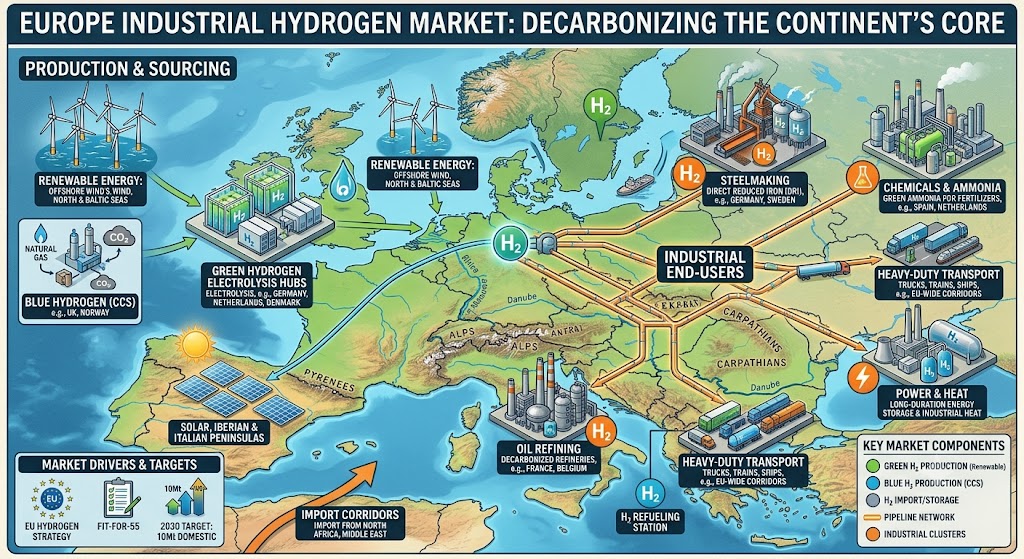
As the European Union advances toward its net-zero emissions target by 2050, industries are increasingly exploring hydrogen as a substitute for fossil fuels and carbon-intensive raw materials. Among all industrial sectors, steel manufacturing, chemicals production, and oil refining are expected to become the largest consumers of low-carbon hydrogen. These industries not only account for a significant share of Europe’s industrial emissions but also represent some of the most immediate opportunities for large-scale hydrogen adoption. Their growing demand is expected to shape investment decisions, infrastructure development, and the overall trajectory of Europe’s hydrogen economy.
Why Industrial Demand Matters for the Hydrogen Economy
The success of Europe’s hydrogen strategy depends on creating sufficient demand to justify investments in production facilities, transportation networks, storage infrastructure, and supporting technologies. While hydrogen has applications across transportation, power generation, and residential energy systems, industrial sectors are expected to provide the initial scale necessary to accelerate market development.
Heavy industries consume vast amounts of energy and feedstocks every year. By replacing fossil-fuel-based processes with low-carbon hydrogen, these sectors can significantly reduce greenhouse gas emissions while creating long-term demand for hydrogen producers.
Strong industrial demand also helps improve project economics by providing stable offtake opportunities. Long-term purchasing agreements between industrial consumers and hydrogen suppliers can reduce investment risks and support the expansion of hydrogen infrastructure throughout Europe.
As a result, industrial adoption is widely viewed as the foundation upon which Europe’s future hydrogen economy will be built.
Steel Manufacturing: The Largest Decarbonization Opportunity
The steel industry is one of Europe’s most carbon-intensive industrial sectors and is expected to become one of the largest future consumers of hydrogen. Traditional steelmaking relies on blast furnaces that use coking coal to remove oxygen from iron ore, generating substantial carbon dioxide emissions in the process.
Hydrogen-based Direct Reduced Iron (DRI) technology offers a transformative alternative. Instead of coal, hydrogen is used as the reducing agent, producing water vapor rather than carbon emissions. When powered by green hydrogen generated from renewable energy sources, this process has the potential to dramatically reduce the carbon footprint of steel production.
Major European steel producers are already investing in hydrogen-based steelmaking projects to meet sustainability targets and comply with increasingly stringent environmental regulations. As these projects move from pilot stages to commercial deployment, hydrogen demand from the steel sector is expected to increase significantly.
The steel industry's scale and emissions profile make it one of the most important drivers of hydrogen market growth across Europe.
Chemicals Industry: A Natural Hydrogen Consumer
The chemical sector is uniquely positioned to accelerate hydrogen adoption because hydrogen is already an essential component of many chemical manufacturing processes. Unlike some industries that must develop entirely new applications, chemical producers can often transition from conventional hydrogen sources to low-carbon alternatives with relatively limited process changes.
Hydrogen is widely used in ammonia production, methanol manufacturing, and numerous industrial chemical processes. Currently, much of this hydrogen is produced from natural gas through carbon-intensive methods. Replacing fossil-based hydrogen with green or low-carbon hydrogen offers a direct pathway for emissions reduction.
Ammonia production represents a particularly significant opportunity. Ammonia serves as a critical ingredient in fertilizer manufacturing, making it essential for agricultural productivity. Low-carbon hydrogen can help create sustainable fertilizer supply chains while reducing industrial emissions.
As Europe expands clean hydrogen production capacity, the chemicals sector is expected to remain one of the largest and most reliable sources of industrial hydrogen demand.
Oil Refining: Transitioning Toward Cleaner Operations
The refining industry is another major consumer of hydrogen and plays a crucial role in Europe’s industrial energy landscape. Hydrogen is used extensively in refining processes such as hydrocracking and desulfurization, which improve fuel quality and help meet environmental standards.
Historically, refineries have produced much of their hydrogen on-site using natural gas. However, growing pressure to reduce emissions is encouraging refiners to explore low-carbon alternatives.
The adoption of green and low-carbon hydrogen can significantly reduce the carbon intensity of refining operations while supporting broader decarbonization goals. In addition, existing refinery infrastructure and hydrogen handling expertise provide a strong foundation for early hydrogen deployment.
Although long-term demand patterns may evolve as transportation becomes increasingly electrified, refineries are expected to remain an important hydrogen consumption center throughout the transition period.
Industrial Clusters Accelerating Hydrogen Adoption
One of the most significant trends in Europe’s hydrogen economy is the development of industrial clusters and hydrogen hubs. These ecosystems bring together hydrogen producers, infrastructure operators, and industrial consumers within a concentrated geographic area.
Industrial clusters offer several advantages. Shared infrastructure reduces transportation costs, improves supply reliability, and enhances economies of scale. They also facilitate collaboration between stakeholders and accelerate technology deployment.
Many of Europe’s largest industrial regions are developing hydrogen hubs focused on serving steel plants, chemical facilities, and refineries. These clusters are expected to become focal points for hydrogen investment and commercialization during the coming decade.
The growth of industrial hydrogen hubs will play a crucial role in creating integrated hydrogen value chains across Europe.
Infrastructure and Supply Chain Development
Meeting the growing hydrogen demand from industrial sectors will require extensive infrastructure investments. Hydrogen production facilities, storage systems, pipelines, import terminals, and distribution networks must all expand significantly to support future consumption levels.
Several European countries are investing in dedicated hydrogen corridors designed to connect renewable energy resources with industrial demand centers. Existing natural gas infrastructure is also being evaluated for potential conversion to hydrogen transportation.
A reliable and interconnected hydrogen network will be essential for ensuring that industrial consumers can access consistent and affordable hydrogen supplies. Infrastructure development will therefore remain one of the most important factors influencing the pace of industrial hydrogen adoption.
Challenges Facing Industrial Hydrogen Deployment
Despite strong momentum, several barriers continue to affect industrial hydrogen adoption. Cost remains one of the most significant challenges, particularly for green hydrogen produced using renewable electricity. In many cases, hydrogen remains more expensive than conventional fossil-fuel alternatives.
Infrastructure limitations, permitting delays, and regulatory uncertainty can also slow project development. Additionally, scaling hydrogen production to meet industrial demand will require substantial expansion of renewable energy capacity and electrolyzer manufacturing.
Many industrial companies must also invest in equipment upgrades and process modifications to fully utilize low-carbon hydrogen. These investments can be significant, particularly for large-scale facilities.
Addressing these challenges will be essential for enabling widespread hydrogen adoption across Europe’s industrial sector.
Future Outlook: Building Europe’s Hydrogen-Driven Industrial Economy
The future outlook for industrial hydrogen adoption in Europe remains highly promising. As climate regulations tighten and carbon pricing mechanisms become more influential, industries will face growing pressure to reduce emissions and adopt cleaner technologies.
Steel manufacturing, chemicals production, and refining are expected to remain the primary demand centers driving market growth. Their large-scale hydrogen requirements will help stimulate investment across the entire hydrogen value chain, from production and storage to transportation and infrastructure.
As technology costs decline and supply chains mature, hydrogen is likely to become an increasingly competitive solution for industrial decarbonization. This evolution will strengthen Europe’s position as a global leader in clean industrial innovation.
Conclusion
Steel, chemicals, and refining are emerging as the key demand centers driving industrial hydrogen adoption across Europe. These sectors account for a significant share of industrial emissions and offer some of the most immediate opportunities for large-scale hydrogen deployment.
By replacing fossil-fuel-based processes with green and low-carbon hydrogen, these industries can substantially reduce emissions while supporting Europe’s broader net-zero objectives. Although challenges related to cost, infrastructure, and scale remain, growing investment and policy support are accelerating progress. As Europe’s hydrogen economy continues to evolve, industrial demand from steel, chemicals, and refining will serve as the foundation for long-term market growth and decarbonization success.