
Peak-Shaving, Demand Response & Energy Arbitrage: Key Revenue Streams for BtM BESS in Europe
Introduction
Europe’s commercial and industrial (C&I) energy sector is experiencing a major transformation as businesses face rising electricity prices, renewable energy volatility, and increasing pressure to improve energy efficiency. In this evolving landscape, Behind-the-Meter (BtM) Battery Energy Storage Systems (BESS) are rapidly becoming essential tools for energy optimization and financial performance. Once viewed mainly as backup power solutions, BtM battery systems are now evolving into intelligent energy assets capable of generating multiple revenue streams.
Across Europe, industrial facilities, logistics hubs, commercial buildings, and data centers are increasingly adopting BtM BESS to lower energy costs, improve operational resilience, and participate in modern electricity markets. Among the most important financial opportunities created by battery storage are peak-shaving, demand response participation, and energy arbitrage. Together, these revenue streams are reshaping how businesses manage electricity consumption and interact with Europe’s rapidly changing energy ecosystem.
Market Momentum Driving BtM BESS Adoption in Europe
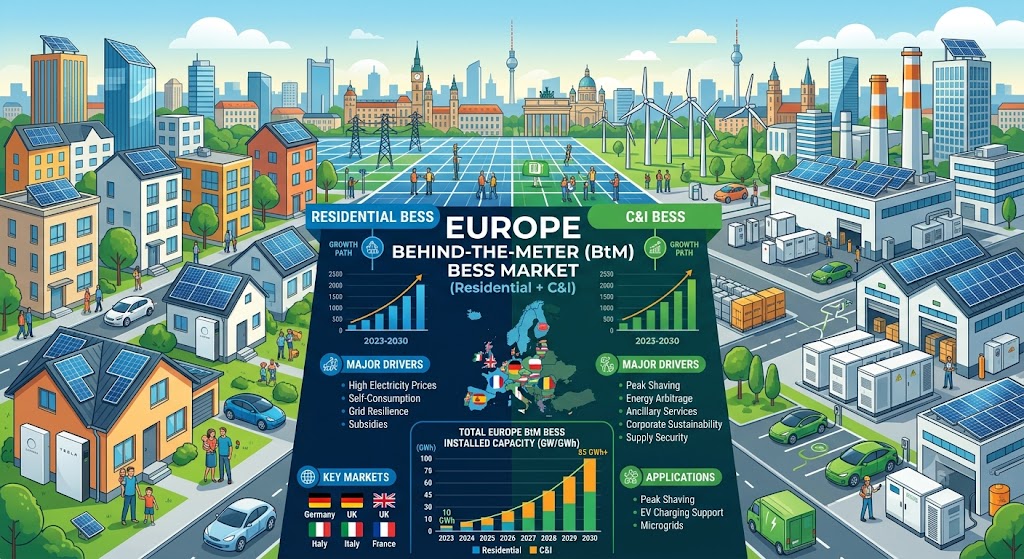
The rapid growth of BtM battery storage across Europe is being driven by several interconnected market factors. Renewable energy generation from solar and wind continues to expand rapidly across EU countries, increasing electricity price volatility and creating greater demand for grid flexibility solutions. At the same time, industrial electricity costs remain high in countries such as Germany, Italy, Spain, and the UK, forcing businesses to search for cost optimization strategies.
Grid instability and congestion are also becoming increasingly common in renewable-heavy regions, creating opportunities for distributed energy resources to support electricity networks. Commercial and industrial sectors including manufacturing, logistics, data centers, and commercial real estate are therefore investing heavily in battery storage systems.
Declining lithium-ion battery costs, supportive energy policies, and increasing participation of decentralized assets in flexibility markets are further accelerating adoption. As return on investment (ROI) improves, BtM BESS is becoming an attractive long-term energy infrastructure investment for businesses across Europe.
Peak-Shaving: Reducing Energy Costs and Grid Stress
Peak-shaving is one of the most valuable and widely adopted applications of BtM battery storage in Europe. This strategy allows batteries to discharge stored electricity during periods of peak demand when electricity prices and demand charges are highest.
For commercial and industrial facilities with large power consumption, peak demand charges can represent a significant portion of overall electricity bills. By using battery storage to reduce reliance on grid electricity during these expensive periods, businesses can substantially lower operational costs.
Peak-shaving also improves energy efficiency and reduces dependency on unstable electricity markets. Industries such as manufacturing, chemicals, logistics, and food processing are increasingly using BtM battery systems to optimize energy usage and improve cost predictability.
In the European context, where industrial energy tariffs are often volatile, peak-shaving is becoming a critical strategy for improving competitiveness. Beyond financial benefits, it also helps reduce stress on national electricity grids by smoothing demand spikes and supporting overall grid stability.
Demand Response: Monetizing Energy Flexibility
Demand response programs are creating another major revenue opportunity for BtM battery storage owners across Europe. Through demand response participation, businesses can support electricity grid operations by reducing consumption or discharging stored energy during periods of high demand or grid stress.
Battery systems are particularly valuable because they can respond almost instantly to changing grid conditions. Through aggregators and Virtual Power Plants (VPPs), distributed battery assets can participate in frequency regulation services, balancing markets, reserve capacity programs, and dynamic load management systems.
As renewable energy penetration increases across Europe, electricity grids require more flexible decentralized resources capable of balancing intermittent power generation. This is driving strong demand for battery-based flexibility services.
Energy Arbitrage: Capturing Value from Price Volatility
Energy arbitrage is becoming one of the most attractive financial opportunities for BtM battery storage operators in Europe. Energy arbitrage involves charging batteries when electricity prices are low and discharging them during periods of high electricity prices.
European electricity markets are experiencing increasing volatility due to renewable intermittency, geopolitical uncertainty, and fluctuating fuel prices. This creates favorable conditions for businesses to profit from electricity price differences throughout the day.
AI-driven energy optimization platforms are helping businesses maximize arbitrage opportunities by analyzing real-time electricity prices and automating charging and discharging schedules. These intelligent energy management systems improve battery utilization and increase financial returns.
As electricity market volatility continues to increase, energy arbitrage is expected to become an increasingly important component of battery storage business models across Europe.
Emerging Business Models Supporting Market Growth
Innovative commercial models are also accelerating BtM BESS adoption across Europe. Energy-as-a-Service (EaaS), battery leasing, shared ownership structures, and solar-plus-storage integration models are helping reduce upfront investment barriers for businesses.
AI-enabled smart energy management systems are improving operational efficiency and optimizing revenue stacking opportunities across multiple energy markets. Energy aggregators are also playing a growing role in combining distributed battery assets into larger portfolios that can participate more effectively in wholesale and balancing markets.
At the same time, infrastructure investors and private equity firms are increasing investment in Europe’s energy storage ecosystem, recognizing battery storage as a critical enabler of the energy transition.
Key Challenges Limiting Market Expansion
Despite strong market momentum, several challenges continue to affect BtM battery storage deployment across Europe. High upfront capital costs remain a concern for many businesses, especially small and medium-sized enterprises.
Regulatory fragmentation across EU countries also creates complexity for project developers and investors. Revenue uncertainty, battery degradation concerns, and grid interconnection challenges can impact long-term profitability.
However, ongoing improvements in battery technology, declining system costs, and expanding flexibility markets are expected to gradually overcome these challenges over the coming years.
Future Outlook: Europe’s Flexible Energy Economy
The future of Europe’s commercial and industrial energy landscape will increasingly depend on decentralized flexibility solutions and intelligent energy infrastructure. BtM battery storage is expected to become a foundational component of Europe’s low-carbon and decentralized power ecosystem.
The expansion of Virtual Power Plants, AI-driven optimization software, distributed energy resources, EV charging infrastructure, and smart microgrids will continue driving demand for battery storage throughout the decade.
By 2030, BtM BESS is likely to play a central role in helping Europe improve grid flexibility, integrate renewable energy, and strengthen industrial energy resilience.
Conclusion
Behind-the-Meter battery storage is rapidly transforming Europe’s commercial and industrial energy sector by unlocking new revenue opportunities through peak-shaving, demand response participation, and energy arbitrage.
Businesses are increasingly viewing battery systems not simply as backup infrastructure but as strategic financial assets capable of reducing energy costs, generating market revenues, and improving operational flexibility.
As Europe continues transitioning toward a decentralized and renewable-powered energy system, BtM BESS will become one of the most important technologies supporting energy independence, grid stability, and long-term industrial competitiveness.