
How Behind-the-Meter Battery Storage is Reshaping Europe’s Commercial & Industrial Energy Landscape
Introduction
Europe’s energy sector is undergoing a major transformation driven by decarbonization targets, renewable energy expansion, and rising electricity price volatility. Commercial and industrial (C&I) consumers are increasingly searching for smarter and more flexible energy solutions that can help reduce operational costs while improving energy reliability. In this rapidly evolving market, Behind-the-Meter (BtM) Battery Energy Storage Systems (BESS) are emerging as a critical technology reshaping Europe’s industrial energy landscape.
Previously viewed mainly as backup power systems, BtM battery storage solutions are now becoming revenue-generating energy assets. Businesses across manufacturing facilities, logistics hubs, commercial buildings, and data centers are adopting battery storage to optimize electricity consumption, improve resilience, and participate in new energy market opportunities. As Europe moves toward a decentralized and low-carbon energy system, BtM BESS is becoming an essential part of modern energy management strategies.
Market Momentum Driving BtM BESS Growth
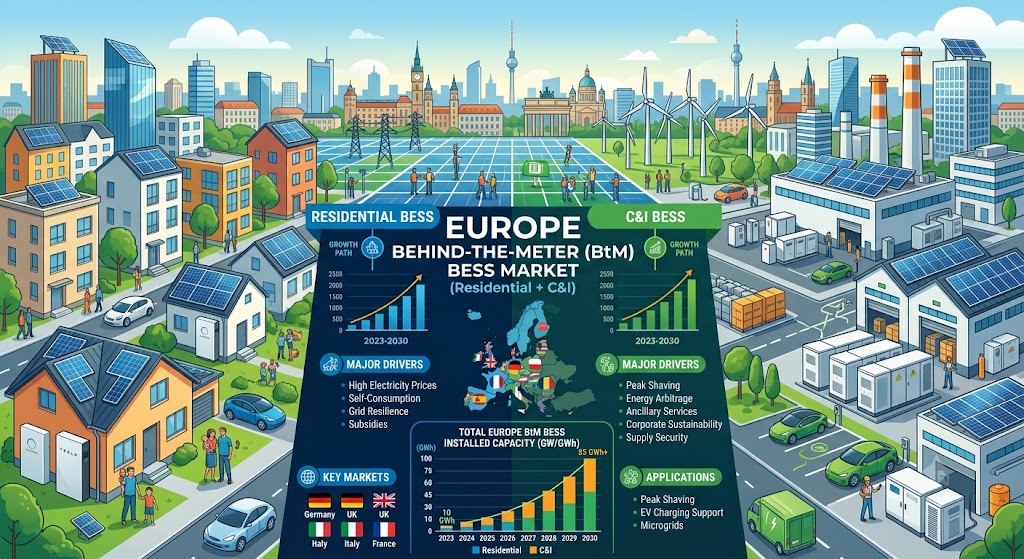
The rapid growth of BtM battery storage across Europe is being fueled by several market factors. The increasing integration of renewable energy sources such as solar and wind has created greater variability in electricity generation, leading to price fluctuations and grid instability. At the same time, industrial electricity costs across countries like Germany, Italy, Spain, and the UK continue to rise, forcing businesses to seek cost-saving solutions.
Battery storage adoption is accelerating across energy-intensive industries because declining battery costs are improving project economics and return on investment (ROI). In addition, European governments and regulators are supporting decentralized flexibility solutions and encouraging participation of distributed energy resources (DERs) in electricity markets. These factors are collectively creating strong momentum for BtM BESS deployment throughout Europe’s commercial and industrial sectors.
Peak-Shaving: Reducing Energy Costs and Grid Stress
Peak-shaving is one of the most important applications of Behind-the-Meter battery storage. It allows batteries to discharge electricity during periods of peak demand when electricity prices are highest. By reducing dependence on expensive grid power during these periods, businesses can significantly lower demand charges and overall electricity costs.
For industrial users with high power consumption, peak-shaving improves operational efficiency and creates faster payback periods for battery investments. Manufacturing plants, logistics facilities, and commercial buildings are increasingly deploying battery storage systems to manage energy demand more effectively.
In the European context, where industrial energy tariffs are often volatile, peak-shaving is becoming a critical cost optimization strategy. Beyond financial benefits, it also helps reduce stress on the electricity grid by flattening demand spikes and improving overall grid stability.
Demand Response: Monetizing Energy Flexibility
BtM battery storage is also enabling businesses to participate in demand response and flexibility markets. Demand response programs allow battery systems to support grid balancing by either reducing electricity consumption or discharging stored power during periods of high demand.
Through aggregators and Virtual Power Plants (VPPs), distributed battery assets can participate in frequency response services, capacity markets, and dynamic load management programs. These flexibility services create additional revenue opportunities for commercial and industrial energy users.
As renewable energy penetration increases across Europe, the need for decentralized flexibility resources is becoming more important. Grid operators increasingly rely on fast-response battery systems to stabilize electricity networks and manage congestion in renewable-heavy regions. This shift is transforming battery storage from a passive infrastructure investment into an active revenue-generating energy asset.
Energy Arbitrage: Capturing Value from Power Price Volatility
Energy arbitrage is another major revenue stream driving BtM battery adoption. This strategy involves charging batteries when electricity prices are low and discharging them when prices rise. Europe’s electricity markets are experiencing increasing volatility due to renewable intermittency and geopolitical uncertainties, creating strong arbitrage opportunities.
Advanced AI-driven energy optimization platforms are helping businesses maximize battery performance by analyzing real-time electricity prices and automating charging cycles. Energy arbitrage is especially beneficial for large commercial and industrial facilities with high electricity demand.
In addition, many businesses are integrating BtM battery storage with onsite solar photovoltaic (PV) systems. This combination allows organizations to store excess solar generation and use it during high-price periods, improving energy self-consumption and reducing grid dependency.
Emerging Business Models in BtM BESS
The BtM battery storage market is also evolving through innovative business models that reduce financial barriers for adoption. Energy-as-a-Service (EaaS), battery leasing programs, and shared ownership structures are helping businesses deploy storage systems without significant upfront capital investment.
Co-location of battery storage with solar PV systems is becoming increasingly common as companies seek integrated clean energy solutions. AI-enabled smart energy management systems are also improving operational efficiency by optimizing battery performance and energy usage patterns.
Energy aggregators are playing a growing role in combining distributed battery assets into larger networks that can participate in electricity markets. At the same time, private equity firms and infrastructure investors are increasing investment in Europe’s energy storage ecosystem due to its long-term growth potential.
Key Challenges Limiting Market Growth
Despite strong growth prospects, several challenges continue to limit the expansion of BtM battery storage in Europe. High upfront installation costs remain a major concern for many businesses, especially small and medium-sized enterprises.
Regulatory fragmentation across European countries also creates uncertainty for investors and project developers. Revenue stacking models can be complex, and long-term profitability often depends on policy clarity and stable market frameworks. Battery degradation concerns and grid interconnection complexities also remain important technical challenges.
However, ongoing technological improvements, falling battery prices, and supportive energy policies are expected to gradually overcome these barriers in the coming years.
Future Outlook: Europe’s Next Phase of Energy Flexibility
The future of Europe’s commercial and industrial energy landscape will be heavily influenced by distributed energy resources and intelligent energy management systems. BtM battery storage is expected to play a foundational role in enabling decentralized, flexible, and low-carbon power systems.
The expansion of Virtual Power Plants, AI-driven battery optimization, EV charging infrastructure, and smart microgrids will further accelerate battery storage adoption across Europe. By 2030, BtM BESS is likely to become a core component of Europe’s energy transition strategy.
Conclusion
Behind-the-Meter battery storage is rapidly evolving from a simple backup solution into a strategic financial and grid-balancing asset for Europe’s energy transition. Through peak-shaving, demand response participation, and energy arbitrage, businesses are unlocking new opportunities to reduce costs, improve resilience, and generate energy-related revenues.
As Europe continues building a decentralized and sustainable energy ecosystem, BtM BESS will become increasingly important in supporting industrial competitiveness, grid flexibility, and long-term energy security.