
EU Grid-Scale BESS Market Outlook: Key Investment Hotspots and Growth Trends Through 2030
Introduction
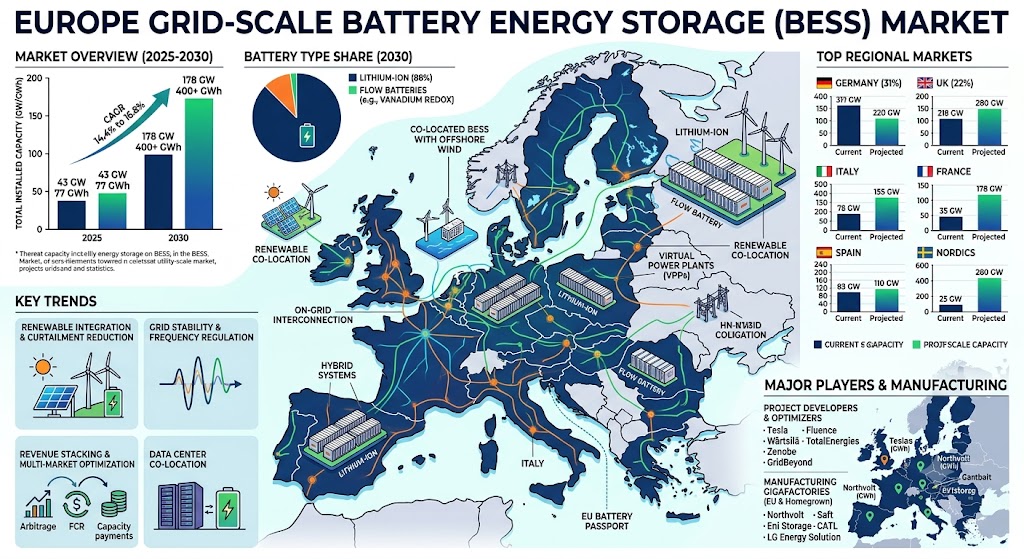
Europe’s energy transition is creating unprecedented opportunities for Grid-Scale Battery Energy Storage Systems (BESS). As the European Union accelerates renewable energy deployment and works toward ambitious decarbonization targets, battery storage is becoming an essential component of the continent’s future power system. The rapid growth of solar and wind energy has increased the need for flexible infrastructure capable of balancing supply and demand, maintaining grid stability, and supporting renewable integration.
Grid-scale BESS projects are increasingly viewed as critical assets that can address renewable intermittency, reduce grid congestion, and provide valuable ancillary services. As a result, governments, utilities, infrastructure funds, and private investors are directing significant capital toward battery storage projects across Europe. With supportive policy frameworks, declining technology costs, and expanding electricity market opportunities, the EU grid-scale BESS market is expected to experience strong growth through 2030.
Market Drivers Accelerating Grid-Scale BESS Deployment
Several structural factors are driving investment in Europe’s grid-scale battery storage market. The most important driver is the rapid expansion of renewable energy generation. Countries across the EU are adding large volumes of solar and wind capacity, creating growing demand for energy storage solutions that can smooth fluctuations in renewable output.
Electricity market volatility is another major growth driver. Increasing price fluctuations create opportunities for battery operators to generate revenue through energy arbitrage, frequency regulation, and balancing services. At the same time, grid operators require more flexible resources to maintain network stability as conventional thermal power plants are gradually retired.
Supportive government policies, energy security concerns, and growing corporate sustainability commitments are also contributing to market expansion. Together, these factors are creating a favorable investment environment for grid-scale battery storage projects across Europe.
Germany: Europe’s Largest BESS Investment Hub
Germany is expected to remain one of Europe’s most attractive markets for grid-scale battery storage investment through 2030. As Europe’s largest electricity market and a leader in renewable energy deployment, Germany faces increasing challenges related to grid balancing and renewable integration.
The country’s ambitious Energiewende strategy continues to drive solar and wind development, creating strong demand for large-scale energy storage systems. Grid-scale batteries are increasingly being deployed to provide frequency control, congestion management, and energy shifting services.
Germany’s advanced electricity market, strong regulatory support, and growing participation in flexibility markets make it a key destination for both domestic and international investors seeking long-term energy storage opportunities.
United Kingdom: A Mature and Competitive Storage Market
Although no longer part of the European Union, the United Kingdom remains one of Europe’s most developed battery storage markets and continues to influence regional investment trends. The UK has established highly active ancillary service and balancing markets that create multiple revenue streams for battery operators.
National Grid's increasing demand for flexibility services, combined with rapid renewable energy growth, has accelerated battery storage deployment across the country. Investors continue to view the UK as a leading market for utility-scale battery projects due to its strong revenue potential and established market mechanisms.
Southern Europe Emerging as a High-Growth Region
Southern European countries are becoming major growth hotspots for grid-scale BESS investment. Spain, Italy, Portugal, and Greece are experiencing rapid renewable energy expansion, particularly in solar power generation.
Spain has emerged as one of Europe’s fastest-growing renewable energy markets, creating significant opportunities for battery storage deployment. Italy is also investing heavily in energy storage to support grid modernization and renewable integration goals.
These countries benefit from abundant solar resources, increasing electricity demand, and growing government support for energy storage technologies. As renewable penetration continues to rise, battery systems will become increasingly important for balancing generation and maintaining grid reliability.
Nordic Countries Driving Innovation in Energy Storage
The Nordic region, including Sweden, Finland, and Denmark, is attracting growing interest from battery storage investors. These countries have strong renewable energy sectors, advanced electricity markets, and ambitious decarbonization strategies.
Battery storage projects in the Nordic region are increasingly supporting wind power integration, grid flexibility, and frequency regulation services. The region's highly digitalized energy infrastructure and strong focus on sustainability create favorable conditions for innovative storage solutions.
As electricity demand grows due to electrification and industrial decarbonization initiatives, Nordic countries are expected to become increasingly important markets for grid-scale BESS deployment.
Key Revenue Streams Supporting Investment
The economic viability of grid-scale battery storage projects depends on the ability to capture multiple revenue streams. Revenue stacking is becoming a common strategy as battery operators participate in various electricity market services simultaneously.
Key revenue sources include:Frequency regulation and ancillary services,capacity market participation,energy arbitrage,grid balancing services,congestion management,renewable energy integration support ,reserve capacity services.
The ability to combine these revenue streams significantly improves project economics and enhances investor confidence. As electricity markets continue evolving, additional monetization opportunities are expected to emerge throughout the decade.
Technology Advancements and Falling Battery Costs
Technological innovation continues to strengthen the business case for grid-scale battery storage. Lithium-ion batteries remain the dominant technology due to their declining costs, improving performance, and widespread commercial availability.
Advancements in battery management systems, artificial intelligence, and predictive analytics are improving operational efficiency and maximizing asset utilization. These technologies enable battery operators to optimize charging and discharging schedules based on market conditions and grid requirements.
In addition, emerging technologies such as long-duration energy storage (LDES), sodium-ion batteries, and hybrid storage systems are attracting increasing attention as Europe seeks more diversified energy storage solutions.
Challenges Facing the Market
Despite strong growth prospects, several challenges remain. Grid connection delays, permitting complexities, and regulatory fragmentation across EU member states can slow project development. Supply chain constraints and fluctuating raw material prices may also impact battery costs and project timelines.
Furthermore, increasing competition in ancillary service markets may place downward pressure on revenues in some regions. Investors must therefore carefully evaluate market conditions, policy developments, and long-term revenue opportunities when planning projects.
However, continued policy support and growing demand for grid flexibility are expected to outweigh these challenges and sustain market growth.
Outlook Through 2030
The outlook for Europe’s grid-scale BESS market remains exceptionally strong. As renewable energy capacity continues expanding, battery storage will become increasingly important for ensuring system reliability and flexibility. Market analysts expect significant growth in installed battery storage capacity across Europe throughout the remainder of the decade.
Investment activity is expected to accelerate as utilities, independent power producers, infrastructure funds, and institutional investors seek exposure to the rapidly growing energy storage sector. Germany, Spain, Italy, the UK, and Nordic countries are likely to remain among the most attractive investment destinations.
By 2030, grid-scale battery storage is expected to become a cornerstone of Europe’s electricity infrastructure, supporting renewable integration, enhancing energy security, and enabling the transition toward a fully decarbonized power system.
Conclusion
The EU grid-scale BESS market is entering a period of rapid expansion driven by renewable energy growth, increasing grid flexibility requirements, and supportive policy frameworks. Investment hotspots across Germany, Southern Europe, the Nordic region, and the UK are attracting substantial capital as stakeholders recognize the strategic importance of energy storage.
With declining technology costs, expanding revenue opportunities, and growing demand for renewable integration, grid-scale battery storage is poised to become one of the most important energy infrastructure investments in Europe through 2030 and beyond.