
Can Long-Duration Energy Storage Solve Europe’s Renewable Intermittency Challenge?
Introduction
Europe's energy transition is accelerating at an unprecedented pace. Ambitious decarbonization targets, rising investments in renewable energy, and growing concerns about energy security are driving the rapid deployment of solar and wind power across the continent. While renewables are becoming the backbone of Europe's future electricity system, their intermittent nature presents a significant challenge. Solar generation fluctuates with daylight hours and weather conditions, while wind output can vary dramatically depending on seasonal and regional factors.
As renewable penetration increases, maintaining grid stability becomes more complex. Traditional fossil-fuel power plants have historically provided the flexibility needed to balance supply and demand, but Europe’s push toward net-zero emissions requires cleaner alternatives. This is where Long-Duration Energy Storage (LDES) is emerging as a critical solution. By storing electricity for several hours, days, or even weeks, LDES technologies have the potential to bridge renewable generation gaps and support a reliable low-carbon energy system.
Europe’s Renewable Energy Growth and the Intermittency Challenge
Europe has become one of the global leaders in renewable energy deployment. Countries such as Germany, Spain, Denmark, and the Netherlands continue to expand solar and wind capacity to reduce dependence on fossil fuels and imported energy sources. However, as renewable generation accounts for a larger share of electricity production, grid operators face increasing challenges related to intermittency.
Periods of excess renewable generation can lead to curtailment, where clean electricity is wasted because the grid cannot absorb it. Conversely, periods of low wind or limited sunlight can create supply shortages and increase reliance on expensive backup generation. These fluctuations highlight the growing need for energy storage systems capable of shifting renewable energy across longer time periods.
Without adequate storage infrastructure, renewable expansion could face limitations that slow Europe's progress toward its climate and energy security goals.
Why Conventional Battery Storage Is Not Enough
Lithium-ion battery systems have played a crucial role in supporting grid flexibility and renewable integration. However, most existing battery projects are designed for short-duration applications, typically providing energy for two to four hours.
While these systems are effective for frequency regulation, peak shaving, and short-term balancing services, they are not designed to address multi-day renewable shortages or seasonal energy imbalances. As renewable penetration increases, Europe requires storage solutions that can deliver power over much longer durations.
Long-Duration Energy Storage fills this gap by extending energy availability beyond traditional battery capabilities. These systems can store surplus renewable energy during periods of abundance and release it when generation falls short, helping ensure a stable and reliable electricity supply.
Technologies Driving the LDES Market
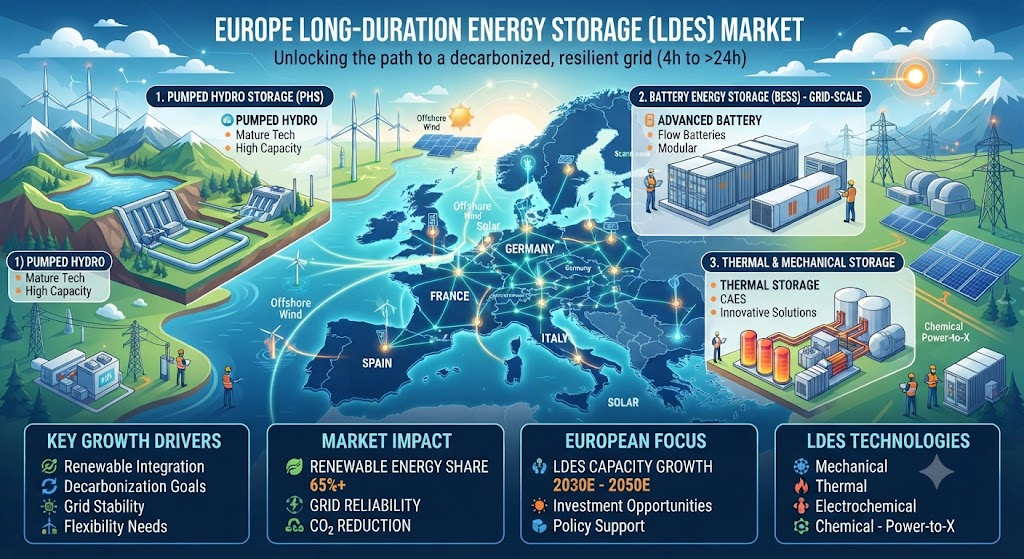
Several technologies are competing to play a leading role in Europe's emerging LDES market. Pumped hydro storage remains the most established long-duration storage technology, offering large-scale energy storage capacity and proven reliability. However, geographical limitations restrict further expansion in many regions.
Flow batteries are gaining attention because they can provide extended discharge durations and longer operational lifespans than conventional lithium-ion batteries. Hydrogen energy storage is another promising solution, allowing excess renewable electricity to be converted into green hydrogen for long-term storage and later use in power generation or industrial applications.
Other emerging technologies include compressed air energy storage (CAES), liquid air energy storage (LAES), thermal energy storage, and gravity-based storage systems. Together, these technologies are expanding the range of solutions available to support Europe's renewable energy transition.
Key Benefits of Long-Duration Energy Storage
The adoption of LDES offers several strategic advantages for Europe's evolving energy system. First, it improves renewable energy utilization by reducing curtailment and maximizing the value of wind and solar generation. Instead of wasting excess electricity, renewable energy can be stored and used when demand increases.
Second, LDES enhances grid reliability by providing backup power during extended periods of low renewable output. This capability becomes increasingly important as fossil-fuel generation is phased out across Europe.
Third, long-duration storage can reduce electricity price volatility by balancing supply and demand over longer periods. This contributes to more stable energy markets and lowers system-wide energy costs.
Finally, LDES strengthens energy security by reducing dependence on imported fuels and supporting a more resilient domestic energy infrastructure.
Market Drivers and Investment Momentum
Growing recognition of the importance of long-duration storage is attracting significant investment across Europe. Governments, utilities, infrastructure funds, and technology developers are increasingly supporting pilot projects and commercial deployments.
Policy initiatives under the European Green Deal and national energy transition strategies are creating favorable conditions for storage development. At the same time, rising renewable energy penetration is increasing demand for flexibility resources capable of supporting grid stability.
Private-sector investment is also accelerating as businesses recognize the long-term value of energy storage in enabling a reliable renewable-powered economy. As technology costs decline and commercialization advances, the Europe Long-Duration Energy Storage (LDES) Market is expected to expand rapidly throughout the remainder of the decade.
Challenges Slowing LDES Deployment
Despite its potential, several barriers continue to limit large-scale adoption of long-duration energy storage. Many technologies remain in the early stages of commercialization and face higher upfront costs compared to mature alternatives.
Regulatory frameworks in several European countries are still evolving and may not adequately compensate storage assets for the full range of services they provide. Revenue uncertainty can make project financing more difficult, particularly for newer technologies.
Infrastructure requirements, permitting processes, and technology-specific deployment challenges can also slow project development. Addressing these barriers will require stronger policy support, targeted investment incentives, and market reforms that recognize the value of long-duration flexibility.
Future Outlook: Building a Resilient Renewable Energy System
Looking ahead, long-duration energy storage is expected to become a cornerstone of Europe's clean energy infrastructure. As renewable generation continues to expand, the need for multi-hour, multi-day, and seasonal energy storage will increase significantly.
The combin ation of advanced storage technologies, supportive policies, and growing private-sector investment is creating a strong foundation for market growth. By 2030 and beyond, LDES is likely to play a central role in balancing renewable generation, improving grid resilience, and supporting Europe’s decarbonization ambitions.
Conclusion
Long-Duration Energy Storage is emerging as one of the most important technologies for addressing Europe’s renewable intermittency challenge. While short-duration batteries will continue to support daily grid operations, achieving a fully renewable energy system requires storage solutions capable of bridging longer gaps in generation.
By improving renewable integration, enhancing grid reliability, reducing price volatility, and strengthening energy security, LDES has the potential to become a critical enabler of Europe’s energy transition. Although challenges remain, continued innovation and investment are positioning long-duration storage as a key pillar of the continent’s sustainable energy future.