
Frequency Regulation, Capacity Markets & Ancillary Services: Monetization Opportunities for Grid-Scale BESS
Introduction
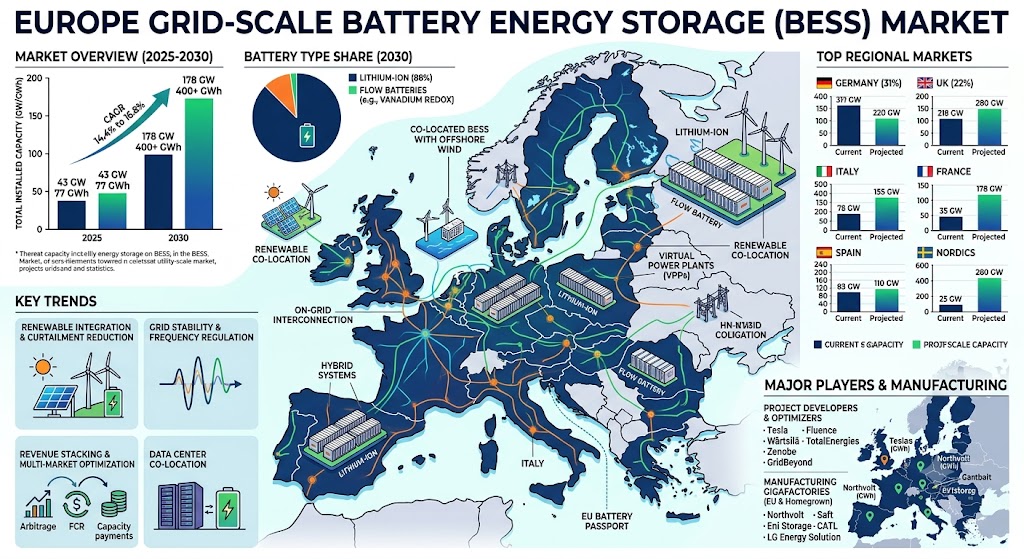
As Europe accelerates its transition toward a renewable-powered electricity system, grid operators are increasingly seeking flexible resources capable of maintaining reliability and stability across electricity networks. The rapid growth of wind and solar energy has transformed power generation across the continent, but it has also introduced new challenges related to intermittency, grid balancing, and frequency management. To address these issues, Grid-Scale Battery Energy Storage Systems (BESS) are emerging as one of the most valuable assets within Europe’s evolving energy infrastructure.
Beyond supporting renewable energy integration, grid-scale battery storage is creating significant revenue-generating opportunities through participation in frequency regulation markets, capacity mechanisms, and ancillary service programs. As Europe’s electricity markets continue to evolve, monetization opportunities for BESS are becoming a key driver of investment and deployment.
The Growing Role of Grid-Scale BESS in Europe
The European energy landscape is experiencing a profound transformation driven by decarbonization targets, electrification, and energy security concerns. Countries across the European Union are rapidly expanding renewable energy capacity to reduce dependence on fossil fuels and meet climate objectives. However, renewable generation sources such as solar and wind are inherently variable, creating greater demand for grid flexibility and balancing services.
Grid-scale battery storage has emerged as a highly effective solution due to its ability to respond almost instantly to fluctuations in electricity supply and demand. Unlike conventional power plants, batteries can switch between charging and discharging modes within seconds, making them ideal for supporting modern electricity grids.
As a result, battery storage operators are increasingly participating in various electricity market segments that reward flexibility, reliability, and fast-response capabilities. These markets provide multiple revenue streams that improve project economics and accelerate investment in large-scale storage infrastructure.
Frequency Regulation: The Fastest-Growing Revenue Stream
Frequency regulation is currently one of the most attractive monetization opportunities for grid-scale battery storage in Europe. Electricity grids operate at a constant frequency, and any imbalance between generation and consumption can cause frequency deviations that threaten system stability.
Battery storage systems are uniquely suited to frequency regulation because they can respond within milliseconds to changes in grid conditions. This rapid response capability allows batteries to inject or absorb electricity almost instantly, helping grid operators maintain stable frequency levels.
European transmission system operators (TSOs) increasingly procure frequency regulation services through competitive markets where battery storage projects can participate alongside traditional power generation assets. Countries such as Germany, the UK, France, and the Netherlands have developed active frequency response markets that reward fast-reacting energy storage systems.
Capacity Markets: Ensuring Long-Term Grid Reliability
Capacity markets provide another important source of revenue for grid-scale battery storage projects. Unlike energy markets, which compensate for electricity generation or consumption, capacity markets reward assets for being available when the grid requires additional power during periods of peak demand.
As coal-fired and conventional thermal power plants are gradually retired across Europe, grid operators are increasingly concerned about maintaining adequate reserve capacity. Battery storage systems are becoming an attractive alternative because they can provide reliable backup power during periods of high electricity demand or supply shortages.
Several European countries have established capacity market mechanisms designed to ensure long-term electricity system reliability. Battery storage projects that meet qualification requirements can receive payments simply for being available to support the grid when needed.
Ancillary Services: Unlocking Additional Revenue Opportunities
Ancillary services represent a broad category of grid support functions that help maintain reliable electricity system operations. These services include voltage control, reserve power, black start capability, reactive power support, congestion management, and balancing services.
Grid-scale battery storage is particularly well-positioned to participate in ancillary service markets because of its flexibility, responsiveness, and ability to provide multiple services simultaneously. Many battery projects generate revenue by offering a combination of frequency response, reserve capacity, and balancing services to transmission and distribution system operators.
The expansion of ancillary service markets across Europe is expected to remain a major driver of battery storage deployment over the coming decade.
Revenue Stacking: Maximizing Battery Project Economics
One of the greatest advantages of grid-scale battery storage is the ability to participate in multiple markets simultaneously through a strategy known as revenue stacking. Rather than relying on a single source of income, battery operators can combine revenues from frequency regulation, capacity markets, ancillary services, and energy arbitrage.
Revenue stacking significantly improves project profitability by diversifying income streams and maximizing battery utilization throughout the day. Advanced energy management software plays a critical role in optimizing participation across various market opportunities based on real-time price signals and grid conditions.
As European electricity markets become more sophisticated, revenue stacking is increasingly viewed as the key to unlocking the full economic potential of grid-scale battery storage investments.
Challenges Affecting Monetization Strategies
Despite strong market opportunities, several challenges continue to affect battery storage monetization across Europe. Regulatory frameworks vary significantly between countries, creating complexity for developers operating across multiple markets. Market rules governing battery participation are still evolving in many regions, which can create revenue uncertainty.
In addition, increasing competition from new storage projects may place downward pressure on certain market revenues over time. Battery degradation and operational optimization also require careful management to ensure long-term profitability.
Nevertheless, ongoing regulatory reforms and growing demand for flexibility services are expected to create increasingly favorable conditions for battery storage participation across European electricity markets.
Future Outlook
The future outlook for grid-scale battery storage monetization in Europe remains highly positive. Renewable energy expansion, grid modernization initiatives, electrification trends, and increasing system complexity are all driving demand for flexible energy resources.
Frequency regulation, capacity markets, and ancillary services will continue to play a central role in supporting battery project economics. At the same time, emerging opportunities in local flexibility markets, congestion management, and cross-border balancing services are expected to create additional revenue streams.
As technology costs decline and market structures mature, battery storage is likely to become one of the most valuable infrastructure assets supporting Europe’s clean energy transition.
Conclusion
Grid-scale battery storage is rapidly evolving into a cornerstone of Europe’s modern electricity system. Through participation in frequency regulation, capacity markets, and ancillary services, battery projects are generating significant revenues while supporting grid reliability and renewable energy integration.
The ability to provide fast-response flexibility and participate in multiple market segments makes battery storage uniquely positioned to benefit from Europe’s energy transition. As electricity systems become increasingly renewable and decentralized, monetization opportunities for grid-scale BESS will continue expanding, driving investment and accelerating deployment across the continent.