
Building Europe’s Clean Energy Future: Nuclear New-Build & Industrial Supply Chains
Introduction: A New Nuclear Era
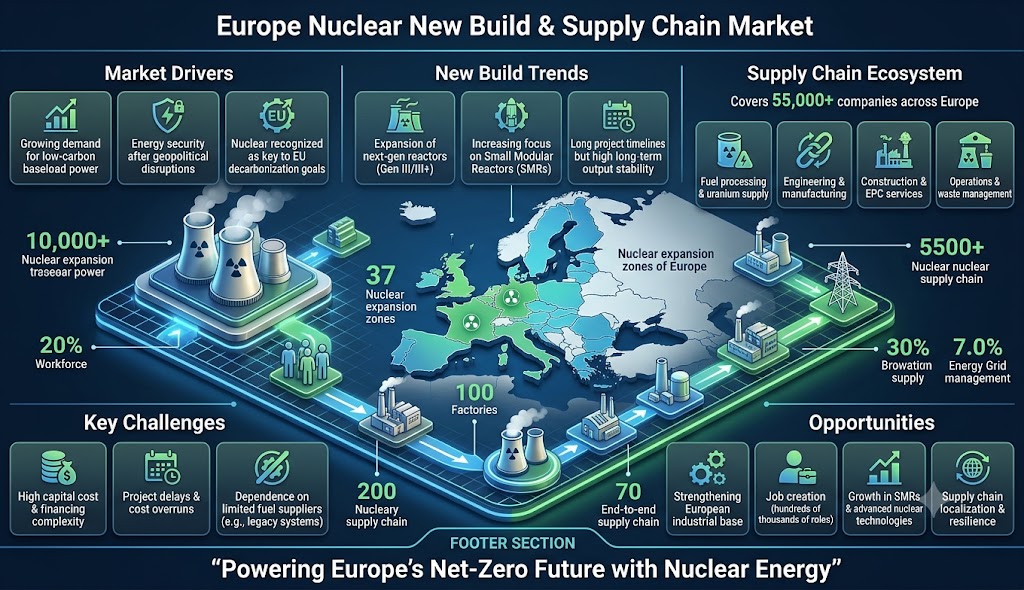
Europe is witnessing a renaissance in nuclear new-build, driven by energy security concerns, decarbonization targets, and the need for stable baseload power. Countries such as France, Finland, Poland, and the Czech Republic have committed to expanding or renewing their nuclear fleets with advanced reactor technologies, including EPRs and SMRs (Small Modular Reactors). As construction projects multiply, the importance of a robust, resilient, and high-integrity supply chain has intensified, becoming a critical component in ensuring timely delivery, cost control, and long-term safety.
As a result, the nuclear supply chain has evolved from a fragmented network of vendors into the strategic backbone of Europe’s new-build program. High-performing supply-chain strategies are now critical for maximizing construction schedule reliability, controlling lifecycle costs, minimizing delays, and protecting project bankability ultimately determining the competitiveness and investability of nuclear new-build. Nuclear reactors operate under extreme safety and regulatory oversight, including seismic resilience, radiation containment, and rigorous material traceability.
What is the Nuclear New-Build Supply Chain?
Nuclear new-build supply chain refers to all activities, vendors, and logistics required to design, manufacture, deliver, and assemble the thousands of specialized components needed for a new nuclear power plant. These services are continuous from pre-construction through commissioning and are essential for maintaining quality, safety, and schedule adherence.
Key components include:
- Heavy Forged Components: Reactor pressure vessels, steam generators, and main coolant pumps produced by only a few specialized foundries globally.
- Instrumentation & Control (I&C) Systems: Digital safety systems and sensors requiring extreme reliability and cybersecurity.
- Balance of Plant: Turbines, generators, cooling systems, and electrical equipment.
- Specialized Logistics: Transport of oversized, ultra-heavy components across multiple EU borders via barges, custom trailers, and protected corridors.
Supply-chain costs account for 40–60% of total project capital expenditure, underlining their strategic importance in nuclear economics.
Why the Supply Chain is Critical
Supply-chain performance has become a decisive factor in the schedule, cost, and long-term viability of nuclear new-build projects. In a highly regulated environment, even a single delayed casting from a specialty forge can halt construction for months, leading to billions in financing costs and extended time-to-market. World-class supply-chain strategies are therefore essential for maximizing construction velocity, optimizing inventory, and minimizing critical-path disruptions.
At a strategic level, reliable supply-chain capabilities ensure the consistent delivery of low-carbon baseload electricity, strengthening grid resilience and accelerating Europe’s shift away from imported fossil fuels. In an industry where financing costs are immense and schedule overruns are costly, superior supply-chain management is no longer optional, it is a core competitive advantage and a key enabler of nuclear power’s contribution to the net-zero transition.
Key Challenges in Nuclear New-Build Supply Chain
Despite its importance, the nuclear supply chain faces several persistent challenges:
- Single or Limited Suppliers: Critical components like large forgings are only produced by a handful of global players (e.g., Framatome, Westinghouse, Rosatom, KHNP), creating bottlenecks and geopolitical risks.
- Skilled Labor & Infrastructure Gaps: Welding, non-destructive examination, and specialized construction trades are in short supply across Europe.
- Cross-Border Logistics Complexity: Moving oversized reactor components across multiple national jurisdictions requires special permits, escorts, and infrastructure upgrades.
- Extremely Long Lead Times: Heavy components can require 3–5 years from order to delivery, complicating project planning.
These challenges highlight the need for strategic stockpiling, modularization, and public-private collaboration to sustain new-build momentum.
Technological Advancements Driving Efficiency
Technological innovation is fundamentally reshaping the nuclear new-build supply chain, shifting the industry from fragmented, document-heavy processes to integrated, data-driven, and modular strategies.
Advanced digital thread platforms powered by AI and blockchain now enable end-to-end traceability from raw material certification to final assembly, significantly reducing quality non-conformances and rework. Digital twins of supply-chain networks allow operators to simulate disruptions, optimize logistics routes, and test inventory strategies in a risk-free environment.
Collectively, these innovations are making nuclear supply chains far more predictable, cost-effective, and resilient directly enhancing construction schedule reliability, reducing financing costs, and strengthening the economic case for large-scale nuclear new-build across Europe.
Industry Players and Policy Support
The European nuclear new-build supply chain is supported by major industry players such as EDF (Framatome), Westinghouse Electric Company, GE Hitachi, Ansaldo Energia, and BWX Technologies. These companies are investing heavily in modular manufacturing, digital quality systems, and long-term strategic supplier partnerships.
Governments also provide loan guarantees, strategic stockpiling programs, and co-investment in heavy forging capacity. Public-private partnerships play a key role in fostering collaboration between utilities, regulators, research institutions, and specialized manufacturers, accelerating the development of a resilient nuclear ecosystem.
Future Outlook: Applications of Nuclear Supply-Chain Services
The future of Europe’s nuclear new-build supply chain is closely linked to the rapid expansion of both large Gen-III+ reactors and SMRs. As projects advance across France, Poland, Czech Republic, Slovenia, and Romania, demand for advanced supply-chain solutions will rise significantly.
AI-driven predictive logistics will enable real-time tracking of critical components across borders, reducing delays and improving inventory efficiency. The integration of digital twins, blockchain quality ledgers, and autonomous transport will further enhance delivery reliability while minimizing human error. Modularization, particularly for SMRs, will shift much construction from site to factory, reducing project risk and time-to-power.Overall, supply-chain services will be a critical enabler in ensuring the reliability, scalability, and cost-effectiveness of Europe’s nuclear expansion.
Conclusion: Building a Sustainable Energy Future
Nuclear new-build supply-chain services are central to Europe’s clean energy transition. While challenges such as limited suppliers, long lead times, and regulatory complexity persist, continuous innovation, strong industry participation, and supportive policies are driving the sector forward. As nuclear capacity continues to grow, efficient supply-chain practices will ensure on-time delivery, economic viability, and long-term safety.
By strengthening this backbone of nuclear energy infrastructure, Europe is not only advancing toward its carbon neutrality goals but also setting a global benchmark for a resilient and future-ready clean energy system.